

UNIRI Pilot Action at the Final Conference
UNIRI Pilot Action at the Final Conference https://opusproject.eu/wp-content/uploads/2025/07/Natasa-Jakominic-1-1024x683.jpg 1024 683 Open and Universal Science (OPUS) Project https://opusproject.eu/wp-content/uploads/2025/07/Natasa-Jakominic-1-1024x683.jpgUniversity of Rijeka Centre for Research and Innovation (UNIRI) Pilot Action
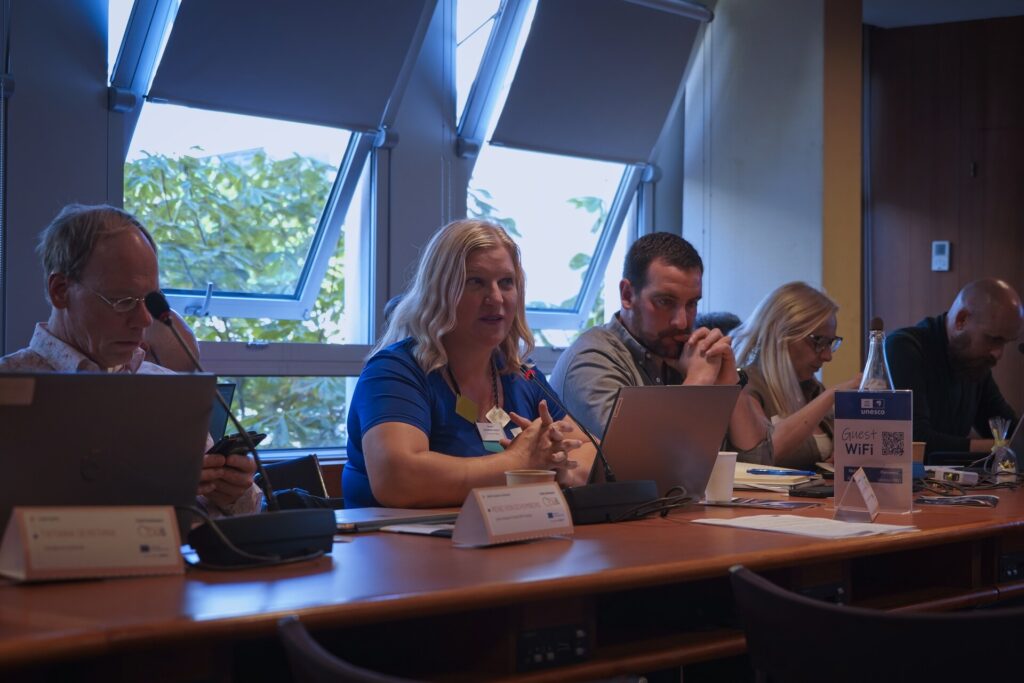
Nataša Jakominić Marot, Head of the University of Rijeka Centre for Research and Innovation (UNIRI), presented the Croatian pilot’s comprehensive approach to Open Science integration at the OPUS Final Conference. With over two decades of experience in driving innovation and research within academia, Jakominić Marot coordinates teams to achieve impactful results whilst contributing to meaningful societal change.
The University of Rijeka pilot focused on implementing Open Science initiatives across research centres, emphasising practical applications in data management, software development, and publication practices. The university’s approach included developing an Open Science Guide, designating library staff as reference points, and selecting specific repositories for different research outputs. While achieving progress in areas like open access publications and software sharing, the pilot encountered challenges including delays in national policies and difficulty retaining early career researchers.
Nataša Jakominić Marot (UNIRI): We built on existing infrastructure, such as the newly established centres
At the University of Rijeka, we have open science experts at the university library, librarians and research managers, whom we consult when designing or implementing open science activities. These experts also contributed to the development of our open science policy. The university library has a dedicated unit, the Centre for Open Science and Information Data Management, which was crucial for OPUS and other initiatives. Slightly before the project, we established the Centre for Science Outreach, which played an important role in valorisation activities. We wanted to boost these activities and make them more central within the university.
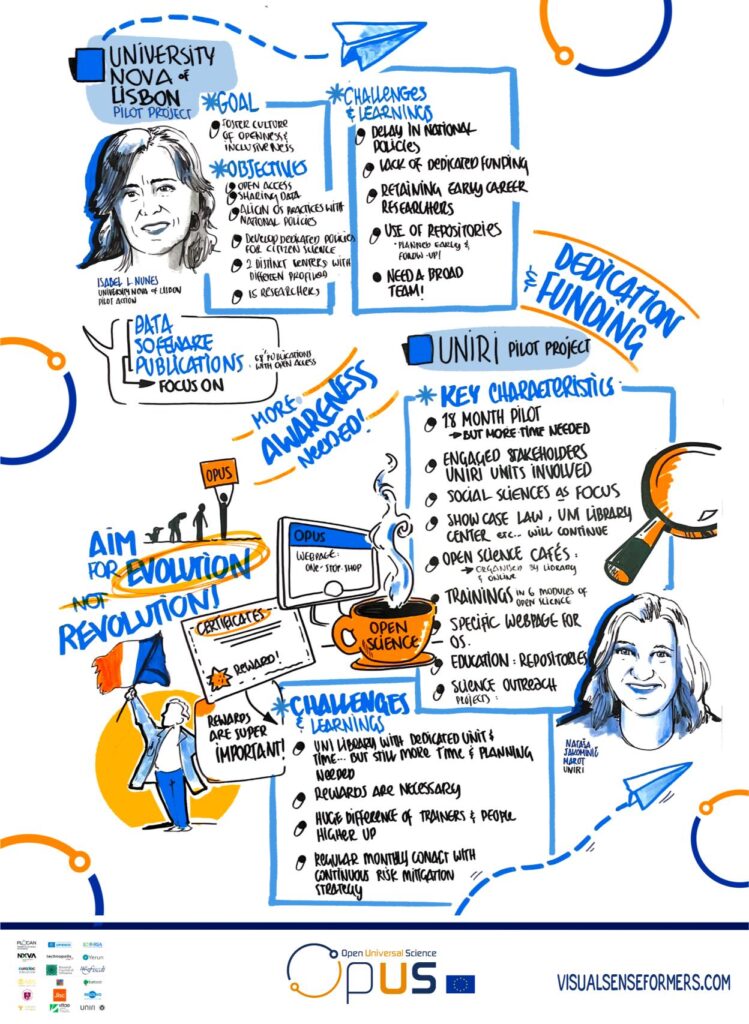
Our pilot cohort comprised 17 early career researchers based at the Faculty of Law, focusing on social sciences. Although the pilot was designed for this specific group, all activities, except those provided specifically by the librarian at the Faculty of Law, were open to any early career or other stage researchers at the University of Rijeka. We saw no need to restrict participation, but when measuring success and tailoring activities, we focused on our project cohort.
The key actions we undertook were aligned with the four domains presented by Gareth and Emma: research, education, valorisation, and leadership. Our activities did not cover leadership. Some activities were relevant to more than one domain, and I will highlight what the three units, the Faculty of Law, the Science Outreach Centre, and the University Library Centre for Open Science, implemented. The circular symbol on our materials indicates activities that will be sustained in the future, as they have generated significant interest and will become regular university activities.
The Centre for Open Science at the University Library began organising Open Science Cafés. We have held six so far, with a seventh planned soon. These cafés address topics requested by early career researchers, and are delivered by our librarians or external experts. We decided to hold these events online, based on feedback from the cohort, to save travel time and allow greater participation. This was a change introduced during the project.
We also provide twice-yearly training on open science skills, which will continue in the future. These comprehensive sessions cover six modules on various aspects of open science and have received positive feedback. The University Library also created a targeted web page specifically for early career researchers, featuring information on training, calls for proposals, and opportunities relevant to open science. This resource has been highly valued by our cohort.
At the Faculty of Law, we have a dedicated librarian who is both a researcher and research manager. She complemented the university library’s training by providing individual sessions or consultations as needed. She delivered training on open science publication skills and, importantly, on repositories. Although we have national and institutional repositories, they can be difficult to navigate. She worked individually with early career researchers to train them in their use, saving them time and facilitating their work.
We originally planned for 65–70% of our cohort to be trained in repositories, but as the university issued a call for funding proposals that required repository use, all cohort members required this training. This demonstrates that when a skill becomes necessary, researchers prioritise it, and we achieved more than anticipated.
For valorisation, the Science Outreach Centre led two types of activities: awareness-raising for researchers and public speaking. We trained researchers on the importance of outreach and on using the project repository. We also provided training in outreach activities, recognising that researchers need to develop these skills. An expert delivered two outreach training sessions during the project.
We built on existing infrastructure, such as the newly established centres, to maximise their value for the university and to embed activities into long-term institutional goals. A key advantage was having a core team member, Sasha, who was formerly vice director. This ensured full support from university management, which is essential for success.
We also created a repository for outreach activities, though it was developed by non-experts due to limited funds. In future, we hope to involve more experts and allocate funds for such work. We used common tools such as YouTube and WordPress, as we could not afford dedicated IT support.
There were many challenges and lessons learned. For any organisation wishing to implement similar activities, I recommend careful consideration of these lessons. Collaboration with the three university centres was vital; without them, we would not have achieved our goals. We assigned partial working hours to library staff for OPUS and open science, but their main duties remained library work, making it difficult to dedicate sufficient time to the pilot. In future, it would be beneficial to have dedicated units and explicit time allocations in contracts, as well as support and incentives for staff. Enthusiasm is important, but it is not enough for sustained, long-term activities.
Open science is known in Croatia, but practices vary greatly between disciplines. Training is available, but not mandatory, so implementation often depends on the team leader or principal investigator. We aimed to change this by focusing on early career researchers, believing that bottom-up influence can be more effective than targeting senior staff.
From the outset, we involved all relevant stakeholders, including the cohort and centre staff, and designated a contact person in each unit. We held an initial meeting to explain roles and reporting, and maintained regular monthly contact, sometimes more frequently, to gather feedback and adjust as needed. This continuous risk mitigation strategy contributed to our success.
For early career researchers, we addressed the lack of tailored support by creating the Edu Doc web page, a one-stop shop for information, contacts, and resources. In terms of rewards, we could only offer certificates, but I strongly recommend more generous recognition in future projects. We hope to introduce more incentives, and our colleague Sasa has worked to influence national research assessment frameworks, advocating for the inclusion of both qualitative and quantitative measures and for open science. We are not yet certain of our impact, but we believe our voice is being heard.
Sustainability was a priority. The timing was ideal, as we had just joined CoARA and were developing our CoARA Action Plan and renewing our HR Strategy for Researchers, which required new analyses and action plans. We have also continued to apply for projects, including the CoARA Boost project with the University of Cyprus, and are now in the implementation phase.
In summary, even if activities are not mandated at the national level, institutions can take action. One should aim for evolution, not revolution, small steps can lead to meaningful change. Academic cultures are difficult to shift, but dialogue and communication are essential. Our activities have increased the university’s visibility nationally and internationally.