UNL Pilot Action at the Final Conference
UNL Pilot Action at the Final Conference https://opusproject.eu/wp-content/uploads/2025/07/Isabel-1-1024x683.jpg 1024 683 Open and Universal Science (OPUS) Project https://opusproject.eu/wp-content/uploads/2025/07/Isabel-1-1024x683.jpgUniversity Nova of Lisbon (UNL) – Pilot Action
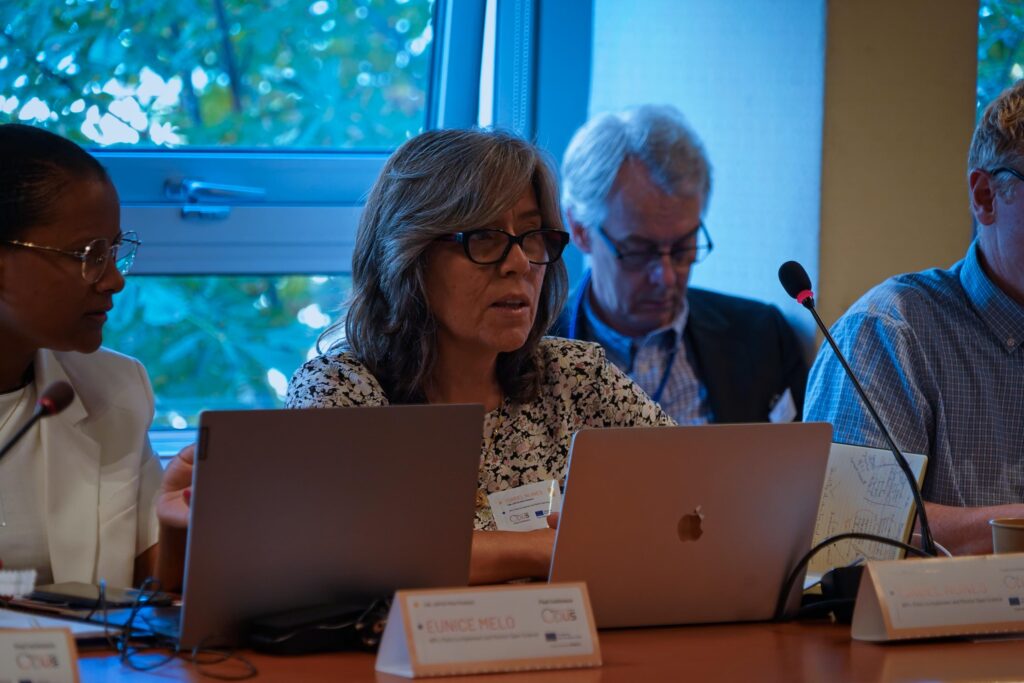
Isabel L. Nunes, Vice-Rector of NOVA University Lisbon responsible for Strategic Planning and Quality Management, demonstrated how the RAF guides institutional policy design and provides concrete support to researchers.
NOVA University Lisbon’s implementation focused on translating the RAF into practical institutional policies and procedures. The university’s approach emphasised providing concrete support to researchers whilst ensuring alignment with European initiatives and national strategies.
Creating a comprehensive open science strategy for the University will be essential to ensure the sustainability of these practices, which was one of our main goals.
Isabel L. Nunes, NOVA University Lisbon: We tested and adapted open science practices in different research contexts
To meet our objectives, we implemented our pilot across two distinct research centres, as already mentioned by Gareth: the Global Health and Tropical Medicine Research Centre and the Information Management Research Centre. These centres have different disciplinary profiles, ensuring diversity in needs and perspectives.
Our cohort consisted of fifteen researchers, mostly early career, from these two research centres. The aim was to test and adapt open science practices in different research contexts, promoting broad adoption across the institution after the project’s conclusion. The pilot focused on four main categories: data, software, publications, and engagement.
The interventions related to policy development, human resource allocation, repository selection, awareness raising, and training workshops.
Some of the key actions we implemented over the eighteen months of the pilot included the following. In the absence of a national open science policy on data, software, and citizen science, NOVA developed and launched the NOVA Open Science Guide to support researchers and ensure alignment with EU standards. This was coordinated by my colleague, Isabel Hoch, Vice Rector for Research and Innovation.
Regarding human resources, library staff were designated as open science reference points, guiding researchers and delivering training and awareness sessions. This demonstrated that internal staff can effectively support open science practices.
NOVA also defined specific repositories for different research outputs: Zenodo for depositing research data, GitHub for managing and sharing software, and RUN, NOVA’s institutional repository, for open access publications, which is integrated with the national repository portal. PURE, our CRIS system, is used for internal monitoring so we can track open science research outputs.
To promote awareness and training, we organised awareness sessions focused on institutional expectations and open science values, as well as seven practical workshops on topics such as open science publication, data management, software sharing, citizen science, and the use of PURE.
We monitored several open science indicators through the OPUS pilot, comparing the starting point in January 2024 with the results achieved by June 2025. Regarding openly available data sets, the Global Health and Tropical Medicine Research Centre began with none and reached the target of three data sets. The Information Management Research Centre also started with none and managed to publish one data set, which, although short of the target of three, reflects their more software-driven focus.
For software outputs, the Information Management Research Centre achieved their full target of three software sets, demonstrating strong engagement with FAIR and open source practices. In terms of open access publications, both research centres started with 68% of their publications openly available, and the cohort successfully achieved one hundred open access publications.
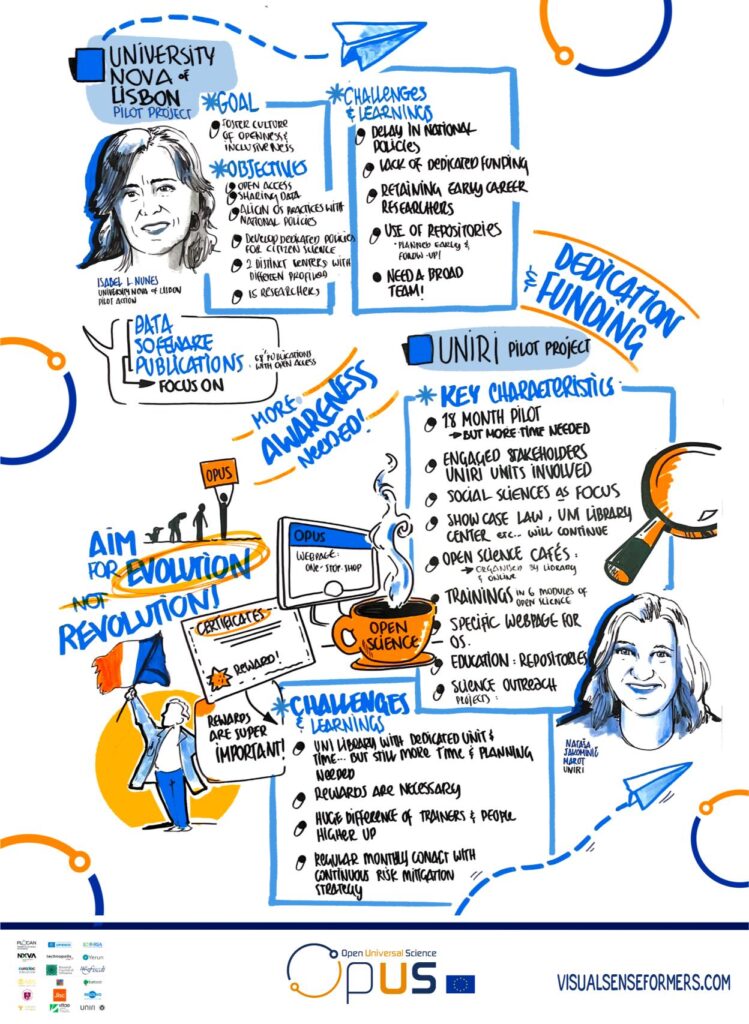
Regarding citizen science, no new citizen science projects were launched during the project, but we did produce three materials and conduct eight citizen engagement activities. This shows partial progress and highlights the challenge of launching fully fledged citizen science projects within a short timeframe, particularly with limited resources and early career researchers. Overall, these results demonstrate NOVA’s progress in key open science areas, especially open access and software, and provide insight into where further institutional support and alignment are needed.
During this journey, we faced several challenges, which provided valuable insights. The first challenge was the delay in national policies for open science. To address this, NOVA produced an internal open science guide, which was essential in supporting researchers in the absence of a national framework.
Another challenge was the lack of dedicated funding and human resources for open science implementation. Library staff served as our open science reference points and did an excellent job, but more support is needed. Retaining early career researchers was also difficult due to contract instability; we learned that sustainable participation requires more stable career pathways and greater institutional support for early career researchers.
Limited awareness of institutional practices among researchers was another challenge. We believe that introducing awareness campaigns is key to embedding open science as a shared institutional value.
In the second phase of implementation, around the ninth month, we experienced low engagement in training due to academic overload, as it coincided with student evaluations and project grant applications. We learned that training should be aligned with the academic calendar and should also offer asynchronous options, such as short videos available online at any time.
Across our cohort, we identified inconsistent use of repositories. Standardising repositories, such as Zenodo and GitHub, would improve monitoring and visibility of open science practices. The absence of a clear repository for citizen science activities was another challenge, indicating that repository solutions must be planned early and supported by policy and infrastructure guidance.
At NOVA, we chose to reward researchers participating in the pilot by considering open science practices in their career progression. However, open science contributions are not yet fully integrated into researchers’ career evaluations. To overcome this, we believe that including open science indicators in the evaluation framework could promote the adoption of open science practices.