UCY Pilot Action at the Final Conference
UCY Pilot Action at the Final Conference https://opusproject.eu/wp-content/uploads/2025/07/Panos-2-1024x683.jpg 1024 683 Open and Universal Science (OPUS) Project https://opusproject.eu/wp-content/uploads/2025/07/Panos-2-1024x683.jpgUniversity of Cyprus (UCY) – Pilot Action
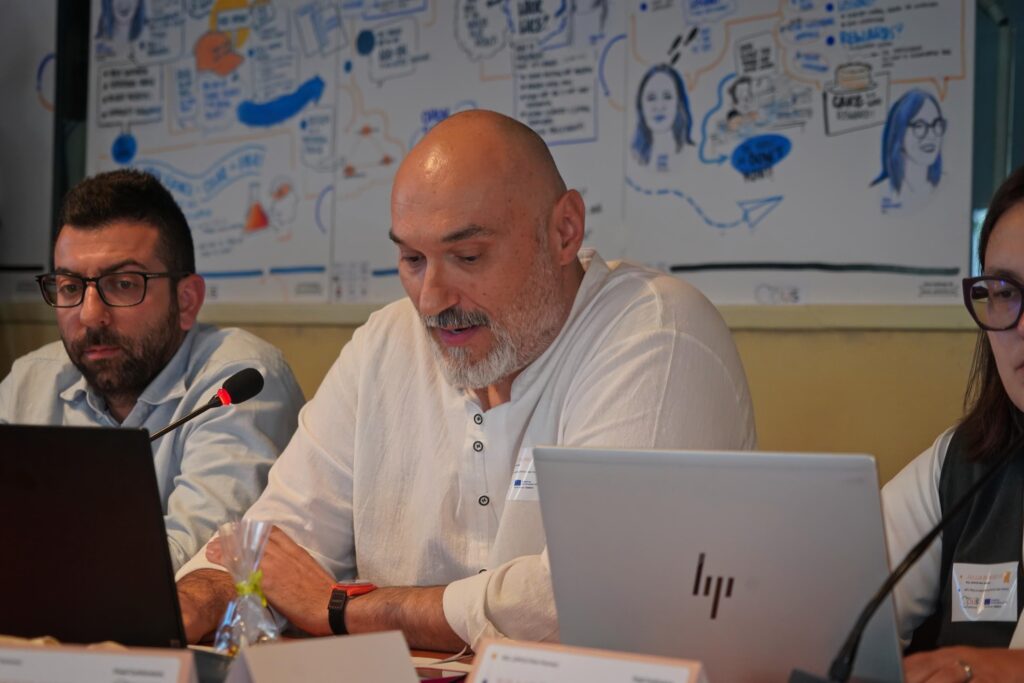
Panagiotis (Panos) Moiras, MSc, BA (Hons), MCIM, Senior Research and Project Management Specialist at the University of Cyprus (UCY), presented the Cyprus pilot’s focus on integrating the RAF into technical practices at the OPUS Final Conference in Paris. Panos brings more than 15 years of experience in project management and communications consultation.
The Cyprus pilot, centred on the KIOS Centre of Excellence, focused on integrating the RAF into practices around publication drafting, data management, and software development. The university played a central role in promoting Open Science principles both institutionally and nationally, having become the first institution in Cyprus to sign the Berlin Declaration on Open Access to Knowledge in the Sciences and Humanities in 2008. The pilot’s achievements included instrumental roles in shaping national policy, leading to the approval of Cyprus’s open science frameworks in 2016 and 2022.
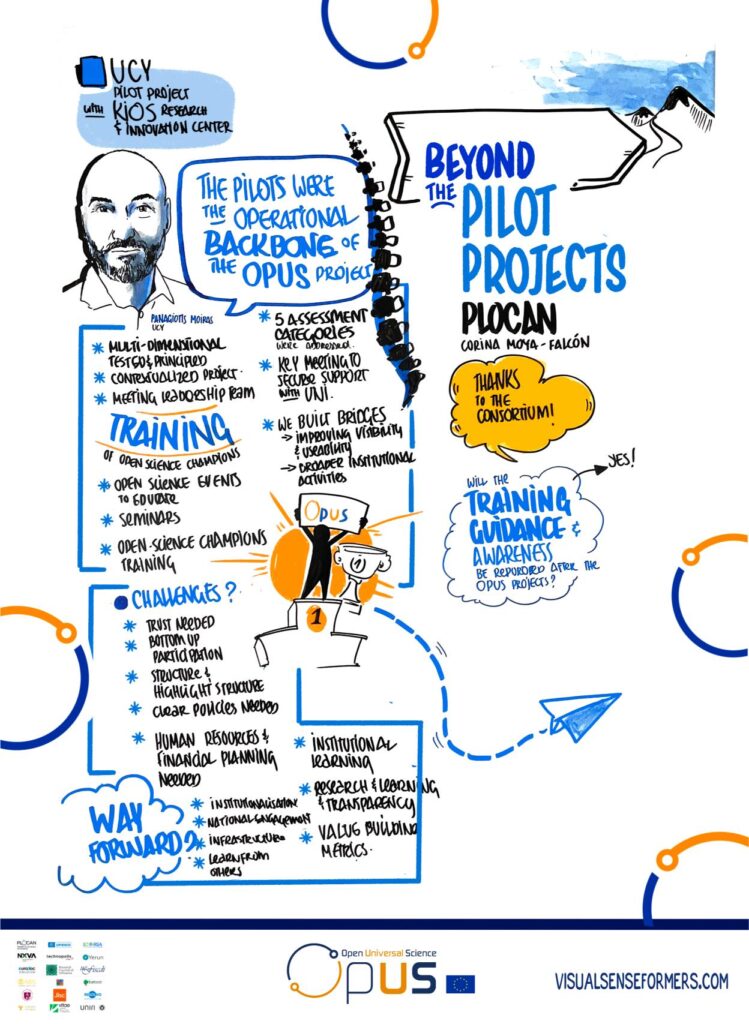
Panagiotis Moiras, UCY: Theoretical reforms were put into practice, tested and refined.
The pilots were the operational backbone of the OPUS project, where theoretical reforms were put into practice, tested and refined. Their success was critical to ensuring that the broader goals of aligning research assessment are met.
This succinctly reflects our journey at the University of Cyprus over the past two years as one of the designated pilot institutions. As a mid-sized, research-intensive university, the University of Cyprus faced both the challenge and the opportunity of translating aspirational reform into functional change.
Our efforts were implemented through the KIOS Research and Innovation Centre of Excellence, the largest information and communication technology research centre in Cyprus.
Turning to the core of our pilot actions, we undertook a multidimensional pilot as part of OPUS. The pilot was not only an opportunity to contribute to European research assessment reform but also to test internally how open science principles could be gradually institutionalised in a research-intensive environment. Our focus was on developing a contextualised, evidence-based, and action-oriented plan aligned with the University’s broader research strategy and the objectives of OPUS.
At the heart of the University of Cyprus pilot was a defined cohort of twelve early-career KIOS researchers. The steps we followed illustrate a structured and collaborative approach to preparing for implementation, ensuring that key roles, criteria, and internal consensus were established early.
The ambition was to create a microcosm of institutional change. The pilot was based on the OPUS Research Assessment Framework. Of the four dimensions, our pilot involved the research category, and included actions relevant to all five assessment categories: policy, resources, repository infrastructure, awareness raising, and training. Specifically, we focused on the subcategories of data, software, and publications, and their corresponding indicator groups.
Policy interventions began with a kickoff meeting of the KIOS Open Science Committee to establish a shared vision and commitment. A significant milestone was the identification and commitment of the twelve early-career researchers forming our core pilot group. We reviewed and identified existing institutional procedures that required amendment to better align with open science principles and to facilitate the pilot’s implementation. To reinforce institutional backing, we held a key meeting with the University’s leadership team, securing their support for the pilot.
An important initiative was the adaptation of the Personal Career Development Plan (PCDP) forms to include explicit references to open science practices. In parallel, the annual Open Science Award at KIOS was restructured to better reflect meaningful open science contributions by incorporating open science indicators.
Resource interventions included the introduction of a new, voluntary role: the OPUS, now called Open Science Champions. We trained two early-career researchers to act as focal points and ambassadors for open science within and beyond the organisation, providing guidance and support. We also assessed and allocated the necessary resources—time, tools, and institutional support. The Open Science Champions underwent a specifically tailored training programme.
Recognising the limitations of available resources, our action plan emphasised strategic planning and ad hoc resource allocation. This included identifying additional funding sources, submitting synergistic proposals, and developing low-cost, high-impact initiatives as proof-of-concept interventions.
Repository interventions focused on building bridges between existing structures. We established a communication channel between our institutional repository, GNOSIS, and those already used by KIOS. Specific actions aimed to improve the visibility and usability of current repositories and to align metadata practices with FAIR principles.
Awareness-raising interventions included several activities to foster broader institutional engagement. We launched an introductory seminar on open science to kick off the pilot, followed by targeted communications such as newsletters and social media campaigns to make open science principles more visible and accessible. We participated in thematic events, such as Open Science Week and Open Science Data Day, which also helped demystify open science for non-research staff and administrative stakeholders.
Training and capacity building involved a comprehensive set of activities: an introductory seminar, targeted training on tools and repositories, and a workshop for the Open Science Champions. This “train the trainer” intervention focused on strengthening communication and soft skills through interactive role-play scenarios. The training prepared participants to navigate diverse perspectives within the academic community. Our final training focused on developing an open science narrative CV. We also encouraged participation in other relevant training organised by stakeholders in the ecosystem, such as the UFA Open Science programme and online seminars and workshops held from November 2024 to January 2025.
Metrics and Outcomes
Marius Kyriakou, Early Career Researcher, KIOS Centre of Excellence
Thank you for the opportunity to join this project and present our results. For the publication drafting indicator group, we set initial targets for months 6, 12, and 18, and achieved our goals. For the data management indicator, we met the target for the number of downloads and came close to targets for other metrics. For the software development indicator, we greatly exceeded two of the four metrics. Researchers became more familiar with open science tools, and we saw more active engagement in open practices. Overall, this was a valuable experience for us at the KIOS Centre of Excellence.
Challenges and Lessons Learned
As with any reform effort embedded in a working institution, we encountered a range of technical, cultural, and structural barriers. Resistance to policy change was one of the most notable challenges. While many approached the interventions with interest, others raised concerns. It became clear that, beyond formal policies, real progress requires open dialogue, relatable examples, and a foundation of trust. Reform is most successful when it involves the academic community from the outset; bottom-up participation and recognition of researchers’ concerns can greatly smooth transitions.
Our pilot highlighted the need for more structured mechanisms to collect and monitor relevant indicators. While there is increasing emphasis on metrics, existing infrastructure and internal policies do not yet fully support systematic tracking. The lesson learned is that metrics are powerful tools, but only if supported by clear policies, trained personnel, and digital systems that make their collection and interpretation routine and meaningful.
As with many pioneering efforts, our pilot unfolded in a landscape of evolving capacity and support. For open science to move beyond rhetoric, institutions must strategically plan for human and financial resources, including lobbying for national-level support and seeking synergistic projects.
Main Achievements
Despite these challenges, our pilot at the University of Cyprus produced a substantive set of achievements:
- Establishing a governance model: The KIOS open science function proved highly effective and can be replicated across departments and institutions.
- Institutional learning: We observed increased institutional literacy around open science within our academic community.
- Changes in research evaluation: By embedding open science criteria into PCDP forms and reinforcing open science with specific tangible and intangible awards, we fostered a process that rewards transparency and collaboration.
- Progress towards CoARA alignment: Our pilot positioned the University to align with CoARA principles, including a shift from proxy metrics to value-based assessments.
- Building momentum for cultural change: With the Open Science Champions leading the initiative, we created a new cohort of early-career researchers who are now both participants and advocates of open science. Their increased visibility, leadership, and reputational standing serve as powerful motivators and drivers of cultural change.
Reflecting on the OPUS pilot at the University of Cyprus, it was not just about testing tools or methodologies, but about surfacing assumptions and revealing where institutional inertia lies and where innovation can thrive.
Looking ahead, we have identified five milestones for our ongoing journey:
- Institutionalisation: Embed successful interventions into permanent structures.
- National engagement: Engage with national agencies and funders to align reward systems.
- Broaden participation: Scale these practices to other departments within the university.
- Invest in capacity: Improve infrastructure and develop tools, and assess human capital requirements.
- Learning from others: Continue engaging with other OPUS pilots, building on synergies and mutual learning.
At the University of Cyprus, we are proud to have contributed to this transformation and to the OPUS project, and we look forward to the future with both pride and anticipation.