Open Science News

Distributing Open Education to Reduce Inequity and Transform Higher Education
Distributing Open Education to Reduce Inequity and Transform Higher Education 900 506 Open and Universal Science (OPUS) Project

In an era where access to knowledge remains uneven, open education and open publishing have the potential to drive significant change in higher education. On Monday, March 3, 2025, from 8:00 pm to 9:00 pm GMT, an online session will explore how open education can be leveraged to promote knowledge equity and transform universities.

The session, hosted by WACREN and Peoples-Praxis, will be led by Emeritus Professor Dick Heller (Australia) and Associate Professor Upasana Gitanjali Singh (South Africa). It will feature discussions on a newly developed open online course, Distributing Education and Knowledge Creation, which is designed to build capacity for distributing knowledge in a way that reduces inequity.

A Collaborative Approach to University Reform

A key aim of the session is to form a cohort of interested participants who will enroll in the course and work through it together. By engaging with the material collaboratively, participants will be able to adapt and refine the course for different educational settings, ensuring its relevance across diverse institutions and communities. The discussion will also highlight ways to use open education to advocate for reforms in higher education.

Session Format and Participation

The event will begin with a short presentation by the speakers, setting the stage for an interactive discussion on the role of open education in reducing barriers to knowledge. Attendees will have the opportunity to share insights, ask questions, and explore strategies for implementing open education practices in their institutions.

By fostering collaboration and inclusivity, this session aims to create momentum for university transformation through open education. Those passionate about knowledge equity, educational access, and systemic reform are encouraged to participate and contribute to this evolving conversation.

To join the session, register here.

DIAMAS Final Project Conference – Save the Date!
DIAMAS Final Project Conference – Save the Date! 900 506 Open and Universal Science (OPUS) Project

The DIAMAS project is excited to announce its final conference, taking place on June 3, 2025, in Brussels, Belgium. This one-day event will highlight the project’s key achievements, explore the current landscape of Diamond Open Access (OA), and discuss the future role of the European Diamond Capacity Hub in supporting and promoting Diamond publishing.

What to Expect

  • Project Review: A look back at DIAMAS’ main accomplishments.
  • State of Diamond OA: Insights into the latest developments and challenges.
  • Community Contributions: Showcasing how DIAMAS outputs have been applied in practice.

Hosted by KBR

The conference will be held in partnership with The Royal Library of Belgium (KBR), providing a prestigious venue for this important discussion.

Get Involved

Details on registration and participation will be shared soon. For now, mark your calendars, and we look forward to seeing you in Brussels!

4th International Colloquium for Research and Action on Academic Integrity: A Call for Collaboration in Higher Education
4th International Colloquium for Research and Action on Academic Integrity: A Call for Collaboration in Higher Education 900 754 Open and Universal Science (OPUS) Project

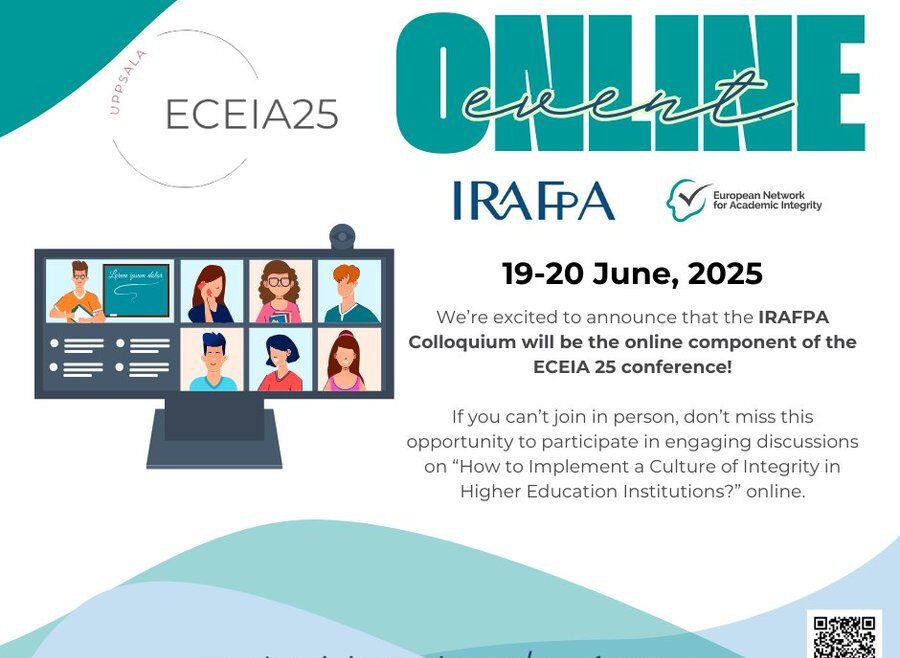
ECEIA 25 is thrilled to announce the 4th International Colloquium for Research and Action on Academic Integrity, a pivotal event dedicated to promoting integrity within higher education institutions. Organized by the Institute of Research and Action on Fraud and Plagiarism in Academia (IRAFPA) in collaboration with the European Conference on Ethics and Integrity in Academia 2025 (ECEIA 25), this online colloquium is set to take place on June 19-20, 2025. While the ECEIA 25 will host an in-person event in Sweden, this virtual gathering ensures that participants from all over the world can engage in this important conversation.

Theme: How to Implement a Culture of Integrity in Higher Education Institutions?

The focus of the colloquium is to explore strategies, research, and practices aimed at fostering a culture of integrity in academic environments. As we confront the challenges of academic social irresponsibility, the event urges us to combine research and action to address critical questions, such as:

  • How do we build a culture of academic responsibility within higher education institutions?
  • How can institutions measure their effectiveness in promoting social responsibility among faculty and students?
  • What are the obstacles to implementing academic social responsibility, and how can they be overcome?
  • How can institutions collaborate with external actors to address these challenges?

Program Highlights

  • Key Presentations: Each session will feature a 20-minute presentation followed by 10 minutes of discussion, allowing for a deeper exchange of ideas.
  • Live Broadcast: The colloquium will begin with a live broadcast of the ECEIA 25 panel discussion.
  • Networking Opportunities: Engaging discussions and networking sessions will allow participants to connect and collaborate on this essential topic.
  • Closing Roundtable: The event will conclude with a roundtable discussion featuring international voices on the future of universities and academic integrity.

Registration Details

  • For Presenters: €100 (or 110 CHF) – Includes IRAFPA membership, access to member events, publication in the journal Les Cahiers de l’IRAFPA, personalized advice on plagiarism or fraud, and more.
  • For Attendees (Non-presenting): €30 (or 30 CHF)
  • For Students (Doctoral & Master’s): €10 (or 10 CHF)

Registration is required, and access will be granted after payment. Interested participants can download the registration form and submit it via email to complete the process.

Important Dates

  • November 1, 2024: Paper proposal submission begins.
  • February 15, 2025: Deadline for paper submissions.
  • March 1, 2025: Acceptance notifications sent to authors.
  • May 6, 2025: Submission of complete papers for publication.

Why Attend?

  • Learn from Experts: Gain insights from leading experts in academic integrity.
  • Best Practices: Discover effective strategies for building a culture of integrity.
  • Networking: Engage with like-minded professionals and researchers.
  • Exclusive IRAFPA Membership Benefits: Enjoy special privileges such as discounted event access, publication opportunities, and more.

The 4th International Colloquium for Research and Action on Academic Integrity promises to be a valuable opportunity for individuals passionate about creating a culture of integrity in academia. Register now and be part of the global conversation that shapes the future of higher education!

Advancing Open Science Through Responsible Research Assessment
Advancing Open Science Through Responsible Research Assessment 900 525 Open and Universal Science (OPUS) Project

Traditional, publication-driven assessments of research are losing momentum as new approaches promoting responsible research assessment and open science gain traction across Europe. These two movements have the potential to reinforce one another: reforming research assessment can accelerate the adoption of open science, while the transparency offered by open science can drive meaningful changes in assessment practices.

To explore this evolving landscape, the Centre for Science and Technology Studies (CWTS) at Leiden University is hosting a series of bimonthly sessions that examine how research assessment can integrate open science and what open science means in practice.

Upcoming Session: The Role of Context in Research Assessment Reform

📅 Date: 12 March 2025
Time: 10:00-11:30 CET

The next Community of Practice (CoP) session will focus on the role of context in responsible research assessment. Insights from nine GraspOS pilot projects initially classified by assessment type have revealed that rigid classifications offer limited practical value. Instead, this session will explore how diverse contextual factors shape research assessment reforms and discuss the principle of making reforms “as aligned as possible, but as diverse as necessary” (Stroobants et al., 2024).

Speakers and Panelists

Presenters:

  • Clifford Tatum (Chair, CWTS / GraspOS)
  • Laura Himanen (CSC / GraspOS)

Panelists:

  • Karen Stroobants (CoARA)
  • Gareth O’Neill (Technopolis Group / OPUS)
  • James Morris (Science Europe)
  • Sarah de Rijcke (Leiden University)

This session will provide valuable insights into how research assessment can evolve to better support open science practices.

🔗 Register now to receive an invitation and event link.

Webinar: Enhancing Academic-Industry Collaboration Through Research Management Tools
Webinar: Enhancing Academic-Industry Collaboration Through Research Management Tools 900 473 Open and Universal Science (OPUS) Project

Driving Innovation and Economic Growth

Collaboration between academia and industry is vital for fostering innovation, economic growth, and sustainable solutions to global challenges. As industry needs evolve, academic institutions must ensure that their research ecosystem—faculty expertise, specialized equipment, and research outputs—is easily discoverable and accessible to potential funders, partners, and collaborators. However, identifying partners with aligned goals, visions, and priorities remains a complex challenge.

The Role of Research Information Management Systems

Advanced research information management systems and centralized profiling tools can help institutions position themselves as valuable partners by improving the visibility and utility of research assets. These tools facilitate seamless management, accessibility, and dissemination of research data, streamlining collaboration efforts between academia and industry.

Webinar on Strengthening Academic-Industry Partnerships

In partnership with Times Higher Education and Digital Science, a panel of experts will explore how these tools enhance research collaboration during a webinar on February 27, 2025, at 11 AM EST / 4 PM GMT. Discussions will highlight key findings from Catalyzing Collaboration: How Research Information Management Systems Drive Academic-Industry Partnerships and address:

  • Benefits and challenges of academic-industry partnerships
  • Strategies for fostering strategic partnerships and resource-sharing
  • Methods to maximize the visibility of research assets
  • How research management tools support technology transfer
  • Measuring the impact of academic-industry collaborations

Expert Panelists

The session will feature leading voices in research collaboration, including:

  • Jeff Agnoli – Senior Liaison, Corporate Partnerships, Ohio Innovation Exchange
  • Derek Newton – Assistant Vice-President, Innovation, Partnerships & Entrepreneurship, University of Toronto
  • Christopher J. Rowe – Executive Director for Industry Collaborations, Vanderbilt University
  • Mike Kagioglou – Pro Vice-Chancellor, Research & Business Innovation, De Montfort University
  • Kate Byrne – SVP Product, Academic & Publishing, Digital Science

This webinar will provide valuable insights for institutions seeking to enhance their research impact and foster meaningful collaborations with industry.

Free Webinar: Best Metadata Practices for Open Access Books
Free Webinar: Best Metadata Practices for Open Access Books 1024 576 Open and Universal Science (OPUS) Project

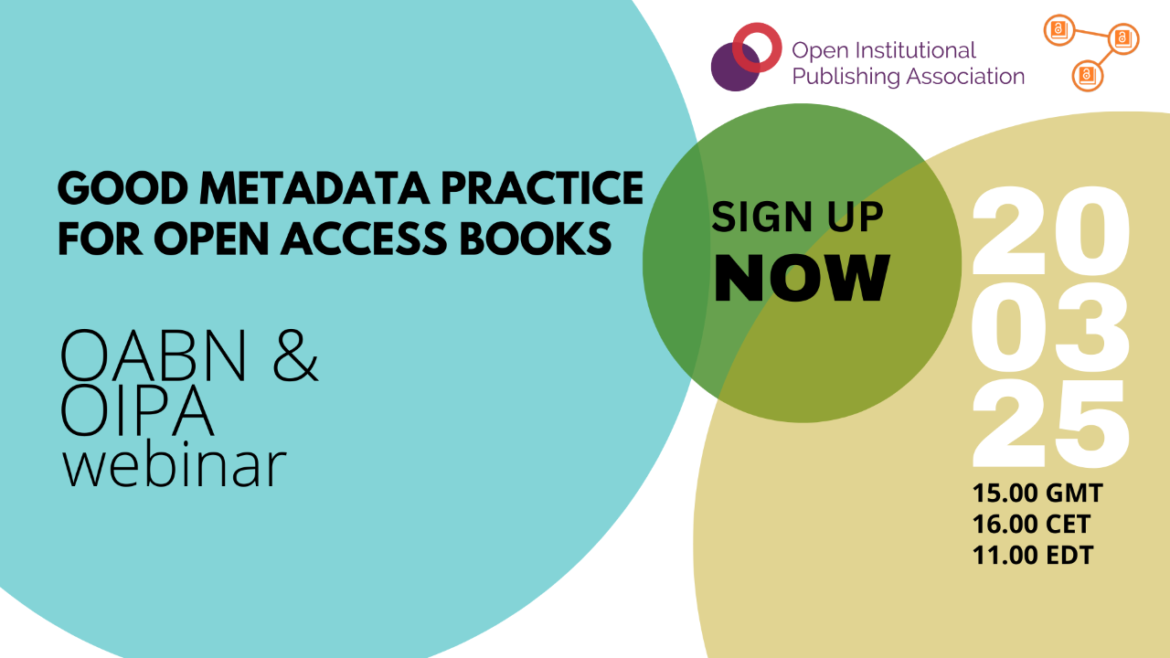
The Open Access Books Network (OABN) and the Open Institutional Publishing Association (OIPA) are hosting a free webinar on best metadata practices for open access books. This session will provide expert insights on optimizing metadata to improve discoverability and accessibility.

Event Details

📅 Date: Thursday, 20 March
Time: 15:00 GMT / 16:00 CET / 11:00 EDT
📍 Format: Online
🔗 Sign up now

What to Expect

Participants will hear from industry experts discussing key metadata principles, followed by an extended Q&A session for in-depth guidance.

Speakers

  • Lucy Barnes (Chair) – Senior Editor & Outreach Coordinator, Open Book Publishers (OABN)
  • Tobias Steiner – COO, Thoth Open Metadata
  • Hannah Hillen – Metadata & Publisher Outreach Specialist, Thoth Open Metadata
  • Graham Bell – Executive Director, EDItEUR
  • Jeffrey Edmunds – Digital Access Coordinator, Penn State Libraries

This session is ideal for publishers, librarians, and researchers looking to enhance the visibility and impact of open access books through effective metadata strategies.

Additional Open Access Training Opportunity

📢 How to Get Your Work Published as Open Access
🔹 Hosted by the School of Advanced Study & University of London Press
📅 Date: Monday, 24 February
Time: 14:00 GMT / 15:00 CET / 10:00 EDT
🔗 Learn more

Speakers

  • Frances Pinter – Director of Academic Relations, Central European University Press & Amsterdam University Press
  • Emma Gallon – Publisher, University of London Press

This annual training session has been fully updated with practical guidance on navigating the latest open access publishing landscape.

📢 Don’t miss out! Sign up today and share these opportunities with your network.

Making Training Materials Matter: Introducing the FAIR-by-Design Methodology
Making Training Materials Matter: Introducing the FAIR-by-Design Methodology 900 506 Open and Universal Science (OPUS) Project

On Friday, March 14, 2025, from 10:00 to 12:30 CET, researchers and educators are invited to join the webinar Making Training Materials Matter: Introducing the FAIR-by-Design Methodology.” This online session, hosted via Zoom, will explore best practices for developing Findable, Accessible, Interoperable, and Reusable (FAIR) learning materials.

Why Attend?

Organized by the Skills4EOSC and ATRIUM projects, the webinar will introduce a six-stage FAIR-by-design workflow to help researchers:
Enhance the quality and impact of training materials
Apply metadata schemas for better organization and discoverability
Publish resources in repositories and training catalogues

A Structured Approach to FAIR Learning Materials

The Skills4EOSC Project has developed the FAIR-by-design methodology, integrating best practices in instructional design, learning platform implementation, and metadata schema definition. This approach ensures that educational resources are easily reusable across research communities.

About the Speaker

The session will be led by Sonja Filiposka, a professor at the Faculty of Computer Science and Engineering (FINKI), Ss. Cyril and Methodius University in Skopje. She is a leading advocate for Open Science, serving as the national EOSC promoter and leading her university’s Open Science Centre. With over a decade of experience in Open Science and EOSC projects, she spearheads the FAIR-by-Design methodology within Skills4EOSC.

Register Now

Secure your spot and be part of the conversation on making learning materials more impactful and reusable.
🔗 Register here

MOOC Open Science: Sharing Your Research with the World
MOOC Open Science: Sharing Your Research with the World 900 506 Open and Universal Science (OPUS) Project

Enhance your research impact and visibility by embracing Open Science. TU Delft’s MOOC Open Science: Sharing Your Research with the World offers an introduction to key Open Science concepts, providing practical tools to help researchers share their work effectively.

Why Join?

This self-paced course covers:

  • Open Data Management & Open Access – Learn how to make research data and publications more accessible.
  • FAIR Software – Ensure your research outputs are Findable, Accessible, Interoperable, and Reusable.
  • Research Visibility – Boost your presence in the academic community.
  • Citizen Science – Engage the public in research initiatives.

Course Details

  • Start Date: Any time between March 5 and December 16, 2025
  • Duration: 6 weeks (approx. 20 hours total)
  • Format: Self-paced online learning

How to Enroll

Take the first step toward making your research more open, collaborative, and impactful!

New Paradigms in Research Communication – Continuing the Discussion
New Paradigms in Research Communication – Continuing the Discussion 680 382 Open and Universal Science (OPUS) Project

ICOR is set to host its first public meeting of the year on February 27 to continue the vital conversation on reshaping research communication. This discussion builds upon insights from the “Future of Open Science Publishing” workshop held at HHMI’s Janelia Research Campus in December 2024, where experts gathered to explore a more collaborative, open, and efficient research ecosystem.

Why This Matters

The current research communication landscape is fragmented, with multiple initiatives operating in parallel. The December workshop sought to align incentives, integrate open science efforts, and establish principles for a robust, transparent research-sharing model. While the discussion began with a select group of 40 experts, ICOR recognizes the need for broader community engagement to shape the future of open science.

What to Expect on February 27

  • David Stern (HHMI’s Janelia Research Campus) will present a researcher’s perspective on why change is necessary.
  • Michele Avissar-Whiting (Director of Open Science Strategy, HHMI) will summarize workshop discussions and outline the next steps.
  • Workshop participants will share key takeaways and actions needed to drive progress.

Be Part of the Conversation

This event marks just the beginning—ICOR is planning further workshops, web meetings, and engagement opportunities in 2025. Don’t miss the chance to contribute your insights and shape the next phase of open science.

📅 Date & Time: February 27 – 8 AM PT | 11 AM ET | 4 PM GMT | 5 PM CET
🔗 Register here
💡 Have ideas for future ICOR meetings? Submit your suggestions via this form or reach out to them directly!

Open Education Week 2025 at TU Delft: Innovate, Share, and Grow Together
Open Education Week 2025 at TU Delft: Innovate, Share, and Grow Together 900 300 Open and Universal Science (OPUS) Project

TU Delft proudly joins the global Open Education Week (OE Week) initiative for the fifth time, celebrating the power of openness in education. From March 3 to March 7, 2025, educators, students, and professionals will gather to explore the latest advancements in open education through engaging discussions, workshops, and collaborative events.

Why Open Education?

Since 2012, OE Week has been a global platform recognizing the efforts of individuals and institutions in advancing accessible and inclusive education. TU Delft’s participation underscores its commitment to empowering educators and learners through open resources, innovative tools, and knowledge-sharing initiatives.

What to Expect at TU Delft’s OE Week 2025

This year’s program is designed to inspire, empower, and connect the open education community. Highlights include:

  • Panel Discussions – Experts will discuss strategies for supporting open education and shaping its future.
  • Interactive Workshops – Hands-on sessions on finding, reusing, and creating Open Educational Resources (OER).
  • Recognition Events – Celebrating Open Education Ambassadors and Open Textbook authors.
  • Innovative Tools Exploration – Discover TeachBooks and DigiPedia for curriculum design and flexible learning.

Whether you’re new to open education or already an advocate, there’s something for everyone!

Program Overview

📍 Day 1 – Monday, March 3: Kick-off

  • Location: TU Delft Library, Main Hall
  • Time: 12:00 – 14:00

📍 Day 2 – Tuesday, March 4: Discover, Reuse, and Create OER

  • Morning Event: TU Delft Library, Main Hall | 12:30 – 13:45
  • Afternoon Event: TU Delft Library, Blauwe Zaal | 15:45 – 17:45

📍 Day 3 – Wednesday, March 5: Open AI Translation Drive

  • Location: TU Delft Library, Blauwe Zaal
  • Time: 12:00 – 13:30

📍 Day 4 – Thursday, March 6: DigiPedia – Facilitating Flexible Curriculum Design

  • Location: TU Delft Library, Blue Hall
  • Time: 12:30 – 13:45

Why Participate?

🎓 Network with professionals and educators passionate about open education.
🏆 Celebrate pioneers and promoters of open education.
🛠 Learn practical tools to enhance teaching and learning experiences.

One Click, a Thousand Words – Open Photo Contest 2025

📅 Submission Period: February 12 – March 7, 2025
🎟 Prize: Win a €25 voucher!
📣 Theme: Share your perspective through photography and contribute to We Like Sharing, TU Delft’s open collection of images.
🏆 Winners Announced: Week of March 17, 2025

TU Delft’s Open Education Week 2025 is an opportunity to embrace open learning, foster collaboration, and shape the future of education. Join and be part of this transformative journey!

Privacy Preferences

When you visit our website, it may store information through your browser from specific services, usually in the form of cookies. Our Privacy Policy can be read here.

Here you can change your Privacy preferences. It is worth noting that blocking some types of cookies may impact your experience on our website and the services we are able to offer.

Click to enable/disable Google Analytics tracking code.
Click to enable/disable Google Fonts.
Click to enable/disable Google Maps.
Click to enable/disable video embeds.
Our website uses cookies, mainly from 3rd party services. Define your Privacy Preferences and/or agree to our use of cookies.