OPUS at the 5th National Open Science Forum in Hungary, 25 October 2023
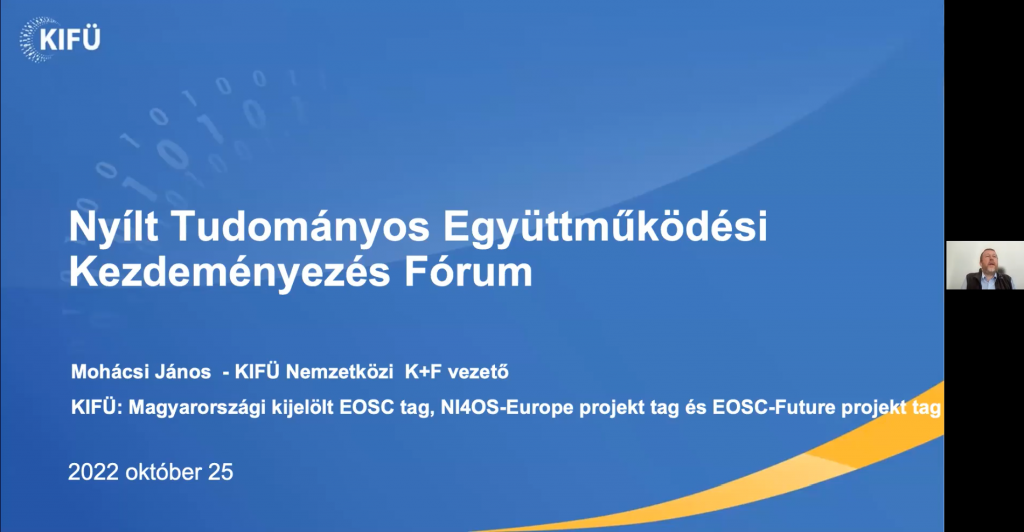
OPUS at the 5th National Open Science Forum in Hungary, 25 October 2023 https://opusproject.eu/wp-content/uploads/2025/08/mohacsi-1024x532-1.png 1024 532 Open and Universal Science (OPUS) Project https://opusproject.eu/wp-content/uploads/2025/08/mohacsi-1024x532-1.pngOn 25 October 2023, Gareth O’Neill from TGB presented the OPUS project’s recommendations on policy, infrastructure interoperability, and researcher incentives for adopting open practices at the 5th National Open Science Forum in Hungary. Alongside developments related to the European Open Science Cloud (EOSC), national Open Science initiatives, and tools such as the NI4OS-Europe services, the forum served as a platform for knowledge exchange and stakeholder engagement.
Hungary’s Open Science Momentum
Hungary has been actively advancing Open Science initiatives throughout 2023. Notably, in October 2021, the country established a Position Paper on Open Science, driven by the National Research, Development and Innovation Office. The paper continues to gain supporters, with an increasing number of organisations endorsing it as a commitment to open research practices. Hungary also played host to the EOSC Regional Event in September, further underscoring its engagement in this field.
About the Event
The forum took place online with around 50 participants. It opened with a welcome from János Mohácsi (KIFÜ), who provided updates on the EOSC. His presentation covered the development of EOSC’s corporate design, monitoring and survey activities related to Open Science, and an introduction to the EOSC Forum. He also summarised the key outcomes of the EOSC General Assembly held earlier in the year, concluding with a forward look at expected developments in the coming years.
Following this, Judit Fazekas-Paragh highlighted the global Open Access Week, noting its focus this year on climate justice. She then presented the results of the EOSC Regional Conference, emphasising its significance in promoting the practical use of EOSC services. Further, she provided insights into the EOSC Strategic Research and Innovation Agenda (SRIA), with particular attention to the ‘New ways of Science’ section.
The final presentation was given by Chrysovalantis Constantinou, an invited speaker, who demonstrated how to benefit from NI4OS-Europe using the SexEst app. Beginning with an overview of EOSC services and the process of service onboarding, he introduced the NI4OS Catalogue and the associated Open Call. He concluded with a detailed introduction to the web application used for gender predictions, illustrating its application of machine learning technologies.
The session ended with an engaging discussion among attendees, who expressed enthusiasm for the next National Open Science Forum.