University of Rijeka Showcases Future-Oriented Research Assessment at PUBMET2025
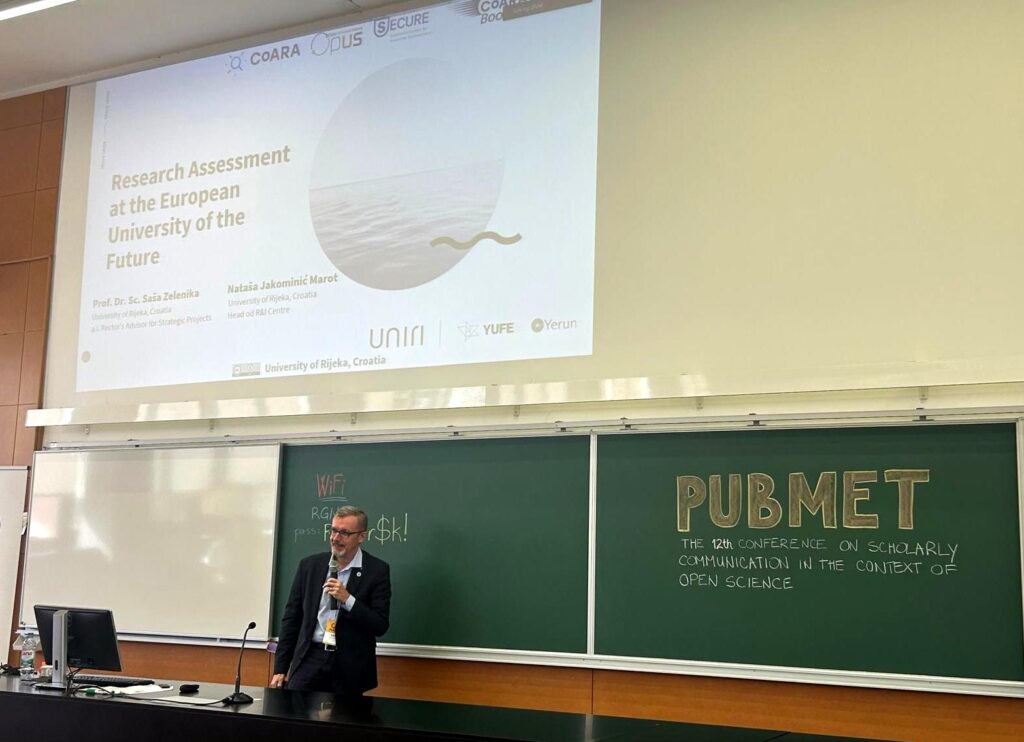
University of Rijeka Showcases Future-Oriented Research Assessment at PUBMET2025 https://opusproject.eu/wp-content/uploads/2025/09/WhatsApp-Image-2025-09-15-at-11.34.10-AM-1-1024x742.jpeg 1024 742 Open and Universal Science (OPUS) Project https://opusproject.eu/wp-content/uploads/2025/09/WhatsApp-Image-2025-09-15-at-11.34.10-AM-1-1024x742.jpegZAGREB, 11 September 2025 – At the PUBMET2025 conference in Zagreb, representatives of the University of Rijeka (UNIRI), Nataša Jakominić Marot and Saša Zelenika, presented their paper Research Assessment at the European University of the Future, outlining the institution’s comprehensive reform in research assessment and its vision for academia’s role in shaping European higher education.
As part of its 2021–2025 strategy, UNIRI has placed its community of teachers, researchers, students and citizens at the centre of its development, embedding engagement, accountability, equity, efficiency, and sustainability within its academic framework. The Croatian university has long stood at the forefront of progressive reforms, becoming the first in the country to adopt the European Commission’s Human Resources Strategy for Researchers (HRS4R) in 2010, and retaining its HR Excellence in Research designation through renewals in 2019 and 2024.
Reforming Research Assessment
UNIRI’s leadership has been vocal in moving away from conventional, metrics-driven research assessment models, which it argues disadvantage early and mid-career researchers. In 2022 the university became an early signatory of the Agreement on Reforming Research Assessment (RRA) under the Coalition for Advancing Research Assessment (CoARA). Since then, it has actively contributed to the coalition’s working groups, especially those focusing on career assessment and the challenges faced by emerging researchers.
Within this framework, UNIRI has implemented a detailed action plan with clear timeframes and responsibilities, and was more recently awarded a Horizon Europe CoARA Boost Teaming project to further strengthen its commitment.
Collaborations and Alliances
The university has drawn extensively on its membership in European alliances such as the Young Universities for the Future of Europe (YUFE) and Young European Research Universities Network (YERUN). Through projects including YUFERING and DIOSI, UNIRI has co-created tools such as a researcher competence framework, an innovative doctoral training model, and narrative CV models for postdoctoral selections.
Through YERUN, UNIRI has also been part of policy-level initiatives promoting recognition and reward mechanisms that extend beyond publication metrics, valuing the diversity of researchers’ contributions across academia, education, leadership, and impact on society.
Contributions to EU Projects
UNIRI’s commitment extends to pilot roles in major EU-funded projects. In the Horizon Europe project SECURE, the university helped develop an innovative Research Career Framework addressing stability, skills, mobility, assessment, and professional pathways. Its successful implementation of 14 targeted measures has contributed to a comprehensive toolbox comprising 80 actions designed for research-performing and funding organisations across Europe.
Within OPUS, where the consortium is working to reshape researcher assessment around open science principles, UNIRI has piloted measures in research, education, and valorisation. These included interventions in areas such as policies, repositories, training, and awareness-raising, reinforcing transparency and mutual learning among partner organisations.
Open Science and Institutional Change
Open Science (OS) remains a pillar of UNIRI’s strategy. The university issued its Declaration on European OS in 2019, adopted its OS policy in 2021 (since updated in 2025), and signed the San Francisco Declaration on Research Assessment (DORA). Alongside EU partners, UNIRI has supported initiatives such as the YUFE OS calendar and the YERUN OS awards, while also promoting ethical AI use through its 2024 AI Tools Usage Policy, shaped by its Centre for AI and Cybersecurity.
The university’s Science Outreach Centre further boosts its citizen science initiatives, pairing researchers with professional science journalists to enhance science communication and community engagement.
Driving Systemic Change
UNIRI has played an influential role nationally as well, advocating for qualitative assessment criteria and integrating open science into Croatia’s evolving framework for academic recruitment and promotion. At the institutional level, it has adopted new regulations and guidelines that redefine criteria for academic staff selection, aiming to nurture a cultural shift among researchers in values, attitudes, and expectations.
Despite challenges and the continued importance of national-level support, UNIRI’s practices highlight the transformative potential of institutional initiatives. Through transparency, inclusivity, strong leadership, and collaboration at the European level, the University of Rijeka demonstrates that universities can act as catalysts for reform, raising both academic quality and international visibility.
UNIRI’s presentation in Zagreb underscored that reforming research assessment is not only about improving metrics but about fostering an environment where diverse contributions are recognised, where careers are sustainable, and where universities are empowered to truly embody the concept of a European university of the future.
References
Coalition for Advancing Research Assessment (CoARA). (2022). The Agreement on Reforming Research Assessment. https://coara.eu/app/uploads/2022/09/2022_07_19_rra_agreement_final.pdf
University of Rijeka. (2024a). Artificial Intelligence Usage Policy at UNIRI. https://zenodo.org/records/11080236
University of Rijeka. (2023a). Guidelines for Additional Criteria for the Selection to Scientific- Teaching, Artistic-Teaching, Teaching, Associate, and Professional Positions of Academic Staff at the University of Rijeka and its Constituents. https://zenodo.org/records/12800551
University of Rijeka. (2025). Politika otvorene znanosti Sveučilišta u Rijeci. https://uniri.hr/wp-content/uploads/2025/02/Politika-otvorene-znanosti_UNIRI_revizija-2025.pdf
University of Rijeka. (2023b). Rules and Regulations on Scientific, Artistic, and Innovation Activities at UNIRI. https://zenodo.org/records/13383045
University of Rijeka. (2024b). University of Rijeka Human Resources Strategy for Researchers – Strategic Priority Areas and Action Plan for their implementation. https://uniri.hr/wp-content/uploads/2024/03/UNIRI_HRS4R_2023-AP-1.pdf
University of Rijeka. (2023c). University of Rijeka Reform of Research Assessment – CoARA Action Plan 2024-2027. https://zenodo.org/records/10634416
University of Rijeka. (2021). University of Rijeka Strategy 2021 – 2025: European University of the Future. https://uniri.hr/wp-content/uploads/2021/04/University_of_Rijeka_Strategy_2021-2025.pdf
Short Biographies of Speakers
Saša Zelenika is a full professor with tenure at the University of Rijeka, Faculty of Engineering. He was Assistant Minister for Science and Deputy Minister at the Croatian Ministry of Science, Education and Sports. He has authored more than 220 scientific and professional publications, 2 textbooks, a patent, 62 broadening newspaper articles, 122 broadening talks and 18 scientific broadening radio shows, and actively participates(ed) in 11 EU FP projects. As UNIRI’s Vice-Rector for Strategic Projects he was in charge of innovation and knowledge valorization activities, head of the EDIH Adria European Digital Innovation Hub, of the HE INNO2MARE Excellence Hub’s Innovation Council, has fostered University’s activities related to open science and AI policies, and has lead the UNIRI activities concerning the reform of research(er) assessment. Currently he is a.i. Rector’s Advisor for Strategic Projects at the University of Rijeka.
Nataša Jakominić Marot is Head of the University of Rijeka Centre for Research and Innovation and an experienced leader in research and innovation. Over two decades in the sector, she has demonstrated expertise in EU project preparation, implementation, and supervision, managing and supervising a portfolio exceeding 100 mEUR. In the last 10 years, she has contributed to 6 Horizon Europe/Horizon 2020 projects in various roles. She is a trainer in project and research management, EU funding, and leadership. She is an expert in EU higher education and R&I policy and international peer reviewer and trainer in her fields of expertise. She is an active member of EARMA, YERUN Policy Platform and two CoARA working groups, and has been at the forefront of the efforts to reform research assessment in Europe, also by strongly promoting the principles of Open Science.