Rethinking Research Assessment: Aligning Open Science with Real-World Reform
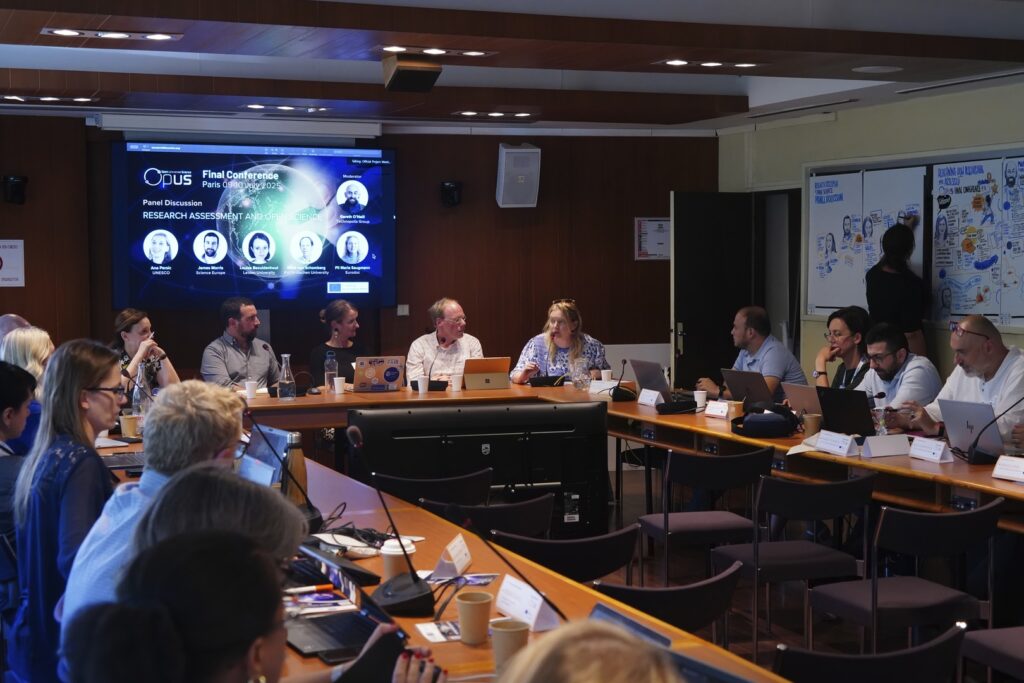
Rethinking Research Assessment: Aligning Open Science with Real-World Reform https://opusproject.eu/wp-content/uploads/2025/07/DSC04536-1-1024x683.jpg 1024 683 Open and Universal Science (OPUS) Project https://opusproject.eu/wp-content/uploads/2025/07/DSC04536-1-1024x683.jpgPanel: Research Assessment and Open Science
Moderator: Gareth O’Neill (OPUS Scientific Coordinator, TGB)
Panelists:
– Ana Persic (UNESCO)
– James Morris (Science Europe)
– Louise Bezuidenhout (Leiden University)
– René von Schomberg (RWTH Aachen University)
– Pil Maria Saugmann (Eurodoc)
The tension between how research is assessed and how science ought to be done in the 21st century is sharper than ever. With Open Science principles increasingly accepted in policy, the reality on the ground still tells a story of resistance, inertia, and misalignment. This panel brought together diverse perspectives, from global policy architects to early career researchers, to explore why research assessment reform is proving so difficult, and what it will take to make change happen.
“We Have a Problem of Misalignment”
Ana Persic from UNESCO opened the discussion with a clear message: the current incentive system is out of step with what Open Science asks of researchers. From her position coordinating the implementation of the 2021 UNESCO Recommendation on Open Science, she sees this misalignment every day. “The incentives, the rewards, the award system is for the moment not aligned with the principles of open science,” she said.
This isn’t just an abstract misfit. It’s a roadblock. The Recommendation frames assessment reform as a cornerstone of open science, yet progress is patchy. Europe is moving, particularly under the CoARA initiative, but in many other regions the conversation hasn’t even started. “We’ve seen a lot of movement towards research assessment reform in Europe, some in Latin America. Other regions are currently not yet engaging in this conversation.”
The Recommendation, she reminded the audience, wasn’t built from scratch. It emerged from years of dialogue involving thousands of stakeholders. Its values, transparency, equity, inclusiveness, collective benefit, are universal. But for many institutions, operationalising these values means upending entrenched practices.
“You Can’t Talk About Open Science in Isolation”
James Morris from Science Europe came in with a practical view from the funders’ side. For him, the key challenge is integration. “You can’t think about open science in isolation. You have to think of it from the perspective of career progression, of how you assess projects, of how you assess researchers, and how that all fits into this broader concept of research cultures.”
Science Europe recently surveyed its member organisations to see where implementation stands. Some parts of Open Science, like open access publications and data sharing, are already well-supported. Infrastructure exists. Training exists. But newer elements, like open peer review or open research methods, remain aspirational. “They’re in strategy documents, but they often don’t have the operational or policy support yet.”
He shared a telling example: data management plans. “If a researcher is funded by an organisation that mandates a data management plan and then moves to one that doesn’t, do they continue to do it? Because they believe it’s good research practice?” If the answer is yes, then culture change has occurred. If not, the system is still stuck in compliance mode, and further thought needs to be given to how interventions can foster more sustainable change.
The Equity Reality: “Opening Up Isn’t the Same as Access”
Louise Bezuidenhout, speaking from Leiden University and the UNESCO Chair on Diversity and Inclusion in Global Science, pushed the discussion deeper. Her central point: openness is not the same as accessibility or equity.
“For many years, we’ve been gathering data on how the current infrastructures supporting research assessment are exclusionary for scholars from low and middle-income countries.” She pointed out that the global South faces multiple invisible barriers, language, digital infrastructure, relevance of metrics, and that simply making data open doesn’t make it usable or meaningful for local communities.
Her dissection of the Recommendation’s values struck a chord: “Of the four core values—transparency, equity and fairness, collective benefit, and diversity and inclusiveness—only transparency is aligned with traditional academic values. The others are about relationships, about dialogue.” And that shift—from individual performance to collective responsibility, is at the heart of why reform is so hard.
“It’s About the Quality of Science, and Its Relevance to Society”
René von Schomberg from RWTH Aachen came with the strongest systemic critique. For him, the way research is currently assessed undermines both scientific quality and societal relevance. “There are actually two bigger reasons for advocating open science,” he said. “One is about the quality of science, and the other one is making science more responsive to societal challenges.”
His examples were blunt. “A former Nature editor told me that 60% of articles in Nature have underlying data that is not reproducible.” That, he joked, would have failed his high school physics class. But the deeper issue is that the current reward structure favours competition and output, not reproducibility or relevance.
He slammed the gold open access model, which, he said, incentivises publishing “as much as possible, whether it’s relevant or not.” The rise of predatory publishing, particularly in biomedical science, is a symptom of this. “In 2015, 6% of journals were predatory or mega channels. Today, it’s 55%. Some publish 10,000 articles per year. That’s 25% of the research output.”
His solution? A total rethink of funding structures. “Instead of giving universities lump sums, fund missions. Assess researchers on how they contribute to societal missions.” It’s not about publications or citations. “It’s about your contribution to the goal to which you’re attached.”
“The System Doesn’t See Us, But We Are the System”
Pil Maria Saugmann from Eurodoc gave voice to those most affected by assessment systems: early and mid-career researchers. Her message was both passionate and precise. “When we talk about research and higher education, I think we should remind ourselves that in Europe, there is a democratic mission.”
OPUS, she said, has demonstrated that change is possible. “We’ve seen real change in the pilot institutions. But it’s vulnerable change. If the next academic leadership doesn’t believe in it, it disappears.”
Her call was for structural change, not just policies, but the very processes that define academic life: habilitation, hiring, funding applications. “If we want reform to matter, I have to see it in the job calls that I and my friends apply to. Not just in strategy documents.”
She also highlighted the issue of precarity. “Most assessment happens at the early and mid-career level. That’s where your next step is on the line. So the reward can’t be a nice diploma on my wall. I have enough of those.”
Most powerfully, she tackled governance. “We’ve changed the researcher landscape in the last 25 years, but not the entry points into academic governance. We are structurally excluded.”
The Trust Gap: “We Are Designing Based on Distrust”
Pierre Winnicke from Trust Inside brought a different lens: trust. For him, much of the resistance to open science isn’t technical, it’s cultural. “We have a leadership based on distrust. Total distrust, probably at every level.”
He introduced the “tree of trust” model, which maps out patterns of dysfunction: lack of co-responsibility, lack of shared rules, competition over collaboration. “Universities and labs are competing with each other instead of sharing. That’s a sign of distrust.”
He posed a provocative question: “Has anyone ever measured the cost of distrust in science, in euros or in political votes? Because once we have that number, maybe leaders will start to act.”
The Economics of Inertia
Sasa Zelenika from the University of Rijeka brought it all back to hard numbers. “The big publishers make €28 billion per year. Multiply that by 7 for a multi-annual framework, roughly €200 billion. That’s twice the Horizon Europe budget.”
And yet, it’s researchers who do the work: “We write the articles. We review them. We edit them. And publishers make the money. That’s a structural problem with values.”
He was equally critical of project-based reform. “You can’t change a system sustainably with a two-year pilot and €500,000. That’s not enough to shift institutions.”
“If We Stay Quiet, Nothing Will Change”
The discussion closed with a sense of urgency. Saugmann summed it up: “We all have to engage in the conversation about FP10. Not just early career researchers, everyone. Because if we’re quiet, nothing happens.”
Persic echoed the call. “The need for science is huge. And people are starting to realise that. That’s our opportunity, to agree on better ways of doing science.”
Von Schomberg offered cautious optimism: “We now have the tools to work openly, to share data and knowledge. The technology is there. The question is: Will we use it to transform the system?”
It’s Time for Structural Courage
The panel made one thing clear: the current system of research assessment is not just outdated—it is actively blocking the implementation of open science. The issue is not a lack of ideas or values. It is a lack of structural alignment, governance inclusion, and institutional courage.
From exclusionary infrastructures and metrics that entrench inequality, to wasteful funding systems and perverse incentives, the problems are systemic. They won’t be solved by adding open science to policy checklists. They will only be solved through coordinated structural transformation, through new ways of funding, assessing, and recognising research.
The OPUS project has shown that change is possible. But as the panelists reminded us, we cannot rely on pilots and principles alone. This will take leadership, trust, courage, and the willingness of the research community to stop waiting for permission and start shaping the future.
The time for marginal reform has passed. What comes next must be nothing short of transformation.