Lesson learnt on how to better support OS policies at institutional level: OPUS Policy Brief
Lesson learnt on how to better support OS policies at institutional level: OPUS Policy Brief https://opusproject.eu/wp-content/uploads/2025/07/Juliana-1-1024x683.jpg 1024 683 Open and Universal Science (OPUS) Project https://opusproject.eu/wp-content/uploads/2025/07/Juliana-1-1024x683.jpgSupporting Open Science at Institutional Level
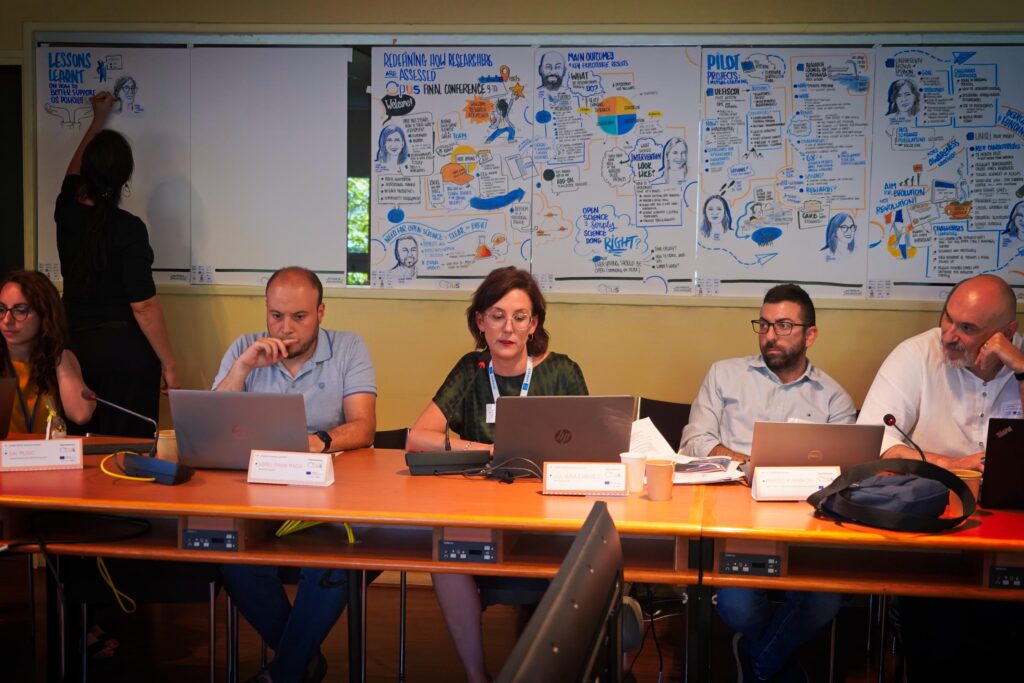
During the OPUS Final Conference held in Paris in July 2025, Juliana Chaves Chaparro, Senior Consultant at UNESCO’s Management of Social Transformations Programme (MOST), presented the OPUS Policy Brief on lessons learnt for supporting Open Science policies at institutional level. Dr Chaves Chaparro brings nearly 25 years of experience in science-policy-society interface promotion, particularly in the Global South, with an advanced degree in Environmental Sciences and ongoing PhD in Sociology.
Her presentation emphasised the importance of aligning policies across local, institutional, national, and European levels whilst integrating gender equality and diversity measures into Open Science initiatives. The policy brief concluded with recommendations for transforming barriers into policy actions, including developing coherent policies, securing resources, and supporting early career researchers and diversity.
Juliana Chaves Chaparro (UNESCO): Recommendations for transforming barriers into policy actions
Juliana Chaves Chaparro of UNESCO has been articulating a path forward for open science, calling on institutions to embrace their responsibility in breaking down barriers and turning them into real policy change. The 2021 UNESCO Recommendation on Open Science serves as a guiding vision, insisting on equity and accessibility as the very foundation of scientific practice. This commitment is echoed in the recent OPUS Policy Brief, which explores how academic and research institutions might successfully transition to open science, using lessons learned from five OPUS case studies as its compass.
The brief doesn’t shy away from the complex realities faced by institutions. It highlights that cultural, structural, and policy-related challenges continue to impede progress, and root causes must be confronted if open science is to flourish anywhere beyond declarations and good intentions. One striking challenge lies in fragmentation—policies and working groups within many institutions operate in silos, with little coordination. Some institutions, especially those participating as pilots, found themselves constrained by the mere absence of robust national policy or by the narrow mandates handed down by government ministries.
No less daunting are the resource constraints: both funding and skilled personnel are often in short supply, stalling or even derailing earnest efforts to embed open science. Resistance to change, both conscious and unconscious, is never far away. This resistance is frequently traced back to traditional markers of academic success, the familiar metrics and the comfort of the status quo.
Early career researchers and women in particular face an atmosphere of precarity and insecurity. High turnover, job insecurity, and fragile retention undermine the long-term commitment so essential to effecting lasting transformation. Further, those who do contribute to open science often find their work unrewarded in the context of career progression. This lack of recognition not only demotivates but also adds to their unpaid workload.
The challenges extend into technical and capacity gaps too, especially in the social sciences and humanities, where the ability to engage meaningfully with society is often hampered by patchy expertise and limited support. Inequities—be they structural or cultural—continue across institutions, with disparities in access, persistent gender issues, and a lack of diversity all creating further hurdles.
The OPUS case studies, however, offer a beacon of practical hope. They have shown that involving researchers, managers, and librarians from the outset, and making the process participatory and inclusive, is transformative. Policies designed with input from a diverse range of voices—across career stages, backgrounds, genders, and traditionally underrepresented groups—are demonstrably more relevant and effective.
Leadership, when visible and committed, makes a measurable difference. The allocation of real resources and open recognition of everyone’s efforts can set the groundwork for change. In some institutional contexts, the creation of open science ambassadors or champions—like those at the University of Cyprus—has ignited broader community engagement and kept open science firmly on the agenda.
In the absence of comprehensive national frameworks, interim policies developed at the institutional level have been invaluable in keeping open science alive and evolving within their own walls. Meanwhile, international exchanges and collaborations have infused these efforts with new ideas and motivation, fostering a spirit of peer support and shared endeavour.
Embedding open science practices into existing research assessment frameworks, alongside consistent capacity building and investment in critical infrastructure, marks another key lesson from the OPUS experience.
But there are still challenges that linger. Far too often, open science is reduced to just open access or a handful of extra initiatives, rather than being embraced holistically, as UNESCO recommends. Three years—the span of the OPUS project—was simply not enough to catalyse the deep-rooted transformation needed. Misalignment between national and institutional policies continues to disrupt momentum, with the risk that researchers may eventually lose interest if support and mandates are not made clear and coherent.
Gender and diversity challenges persist stubbornly as well. The lack of disaggregated data, ongoing gender bias, and inadequate support for caregivers and underrepresented groups are all formidable obstacles.
So, what does the Policy Brief urge? First, it calls for the alignment of policies from the local to the global level, ensuring coherence and clarity throughout. Adequate resourcing—funding and dedicated staff—is non-negotiable for real progress. Open science must be woven into researcher assessment, so its value is embedded in career progression and not simply an afterthought. Investment in training, infrastructure, and ongoing community engagement is essential.
Specific measures must also address the needs of early-career researchers, caregivers, and those from marginalised backgrounds. Gender equality and diversity should no longer be side issues, but mainstreamed within open science strategies and everyday practice. Centralised infrastructure for data management and monitoring is vital, supporting the accessibility and longevity of the transition. The spirit of collaboration should extend beyond borders, with international working groups and knowledge exchange becoming routine features of institutional activity.
Sustainable transformation, as Juliana Chaves Chaparro and UNESCO make clear, is not achieved through piecemeal or tokenistic efforts. Only comprehensive, coordinated action, rooted in inclusivity, gender equality, and diversity, can truly advance open science and rebuild the public’s trust in research. Institutions are therefore encouraged to answer open calls for action, to support national monitoring initiatives, and to participate fully in evolving working groups on financing, incentives, policy, and strategy. Only by advancing together, as a genuine community, does meaningful change become not just possible, but inevitable.