Eurodoc Conference 2024: OPUS Highlights Calls for Reform in Research Assessment
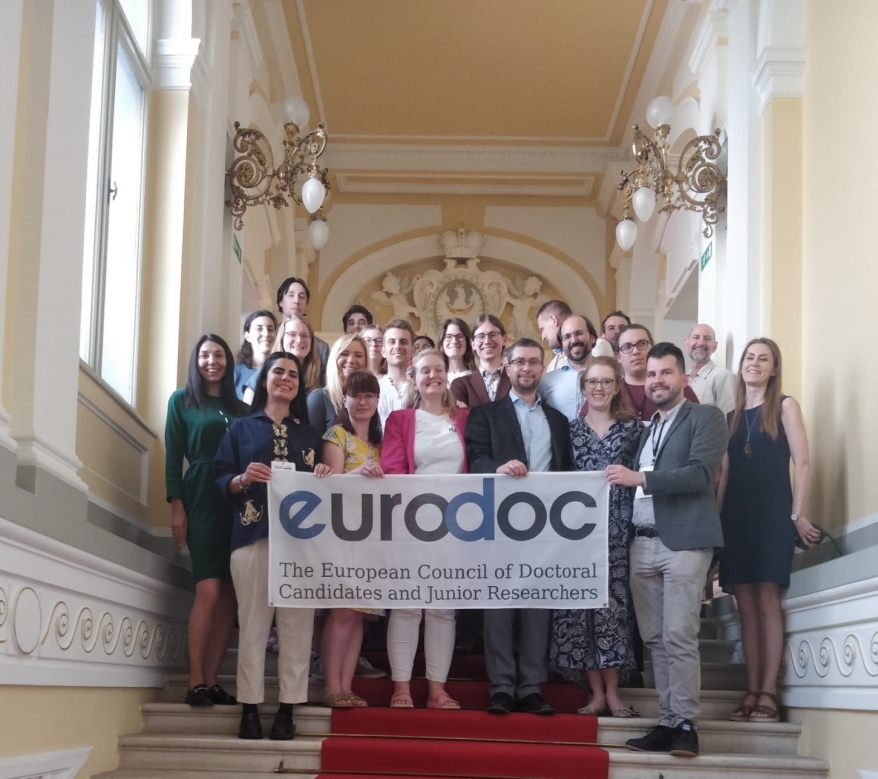
Eurodoc Conference 2024: OPUS Highlights Calls for Reform in Research Assessment https://opusproject.eu/wp-content/uploads/2025/08/Eurodoc.jpg 878 779 Open and Universal Science (OPUS) Project https://opusproject.eu/wp-content/uploads/2025/08/Eurodoc.jpgThis year’s Eurodoc Conference, entitled “Towards a United European Research Area: The Ljubljana Process and Beyond,” drew early-career researchers, policymakers, and academic leaders from across the continent to the Faculty of Law at the University of Ljubljana, Slovenia. The two-day event (June 4-5, 2024), jointly organised by Eurodoc and the Young Academy of Slovenia (Mlada akademija), with support from the Ministry of Higher Education, Science and Innovation of Slovenia, the University of Ljubljana, CTK, and IZUM, spotlighted the urgent need to address persistent imbalances in Europe’s academic systems, and showcased the role of initiatives like OPUS in charting a renewed path forward.
OPUS in the Spotlight
During the conference, Sebastian Dahle presented the contributions of the OPUS project to the ongoing reform of research assessment systems in Europe. Focusing particularly on the perspectives of early-career researchers (ECRs) within the European Research Area (ERA), Dahle outlined OPUS’s advocacy for fairer, more transparent, and inclusive evaluation frameworks. The project’s commitment to empowering ECRs featured prominently, with emphasis on the challenges and opportunities facing this vital demographic within rapidly evolving academic landscapes.
Fragmentation and Brain Circulation under Scrutiny
Discussions in Ljubljana built on two decades of reflection, acknowledging developments since the original launch of the ERA and setting out new ambitions to bridge persistent divides. Delegates noted the enduring problem of uneven brain circulation within the EU, particularly between the so-called EU-13 and EU-14 member states. Despite years of concerted effort, closing these gaps remains an elusive goal, underscoring the continued relevance and urgency of the Widening Programme.
A key highlight was the panel discussion exploring the impact and limitations of the Widening Programme, first launched as part of the Ljubljana Process in 2008. The initiative aimed to overcome fragmentation in the ERA and anchor research policy as a pillar for European competitiveness. Although recent studies suggest “moderately promising results,” with the Widening countries beginning to approach the EU27 average, persistent barriers to asymmetric participation remain.
Calls for Reform and Greater Integration
Conference sessions unpacked contrasting national perspectives on the future of the Widening Programme. While some member states have called for the programme to be decoupled from the EU’s Framework Programme, others advocate stronger integration, a reframed focus, or increased funding to heighten its impact and appeal. The European Court of Auditors, amongst other voices, emphasised that meaningful improvement will hinge on sustained national efforts and further tailoring of the policy agenda.
Participating organisations, including LERU, ISE, and Science Europe, contributed nuanced analyses and underlined the need for revisited approaches, highlighting both best practices and ongoing shortcomings. The panel sought to examine divergent rationales, showcase positive examples from successful Widening countries, and debate new strategies to build research capacity and move towards a truly inclusive European Research Area.
Best Practices and Inclusive Capacity Building
The consensus emerging from the Eurodoc Conference 2024 was clear: while the Widening Programme remains “valuable,” its limitations demand fresh thinking, more flexible allocation of funding, and greater collaboration among national research ecosystems. At the same time, OPUS’s focus on early-career researchers and reforming assessment systems was cited as an exemplar for addressing the new challenges facing Europe’s research community.
As the ERA continues to evolve, initiatives such as OPUS, coupled with critical scrutiny of structural programmes, remain at the forefront of calls for a united, equitable, and globally competitive European research landscape.