OPUS at the YERUN Open Science Awards 2024 Ceremony
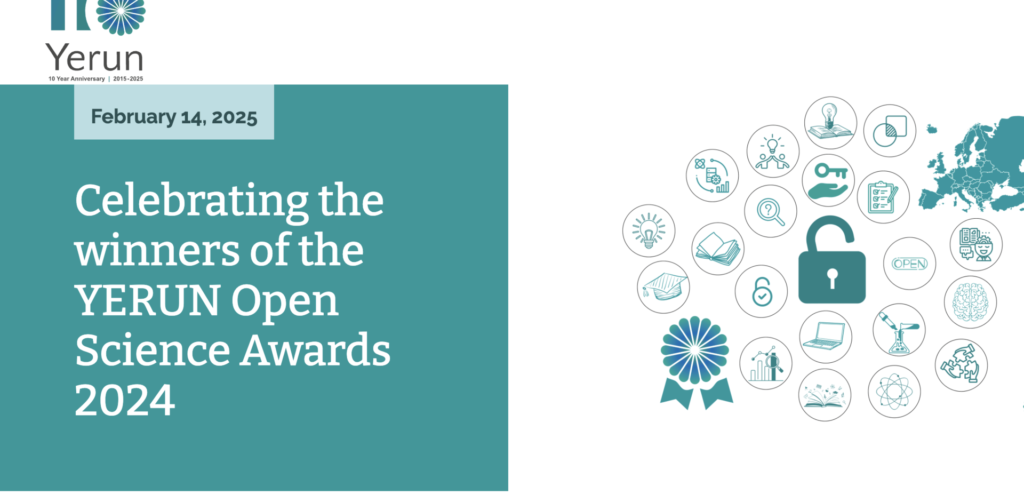
OPUS at the YERUN Open Science Awards 2024 Ceremony https://opusproject.eu/wp-content/uploads/2025/08/YERUN-awards-1024x494.png 1024 494 Open and Universal Science (OPUS) Project https://opusproject.eu/wp-content/uploads/2025/08/YERUN-awards-1024x494.pngAt the YERUN Open Science Awards 2024 ceremony, OPUS was featured as part of YERUN’s commitment to advancing Open Science practices. The event celebrated outstanding projects that embody transparency, accessibility, and collaboration in research, with OPUS serving as an example of transformative research assessment reform.
The YERUN Open Science Awards 2024 Ceremony took place virtually, recognising outstanding projects that exemplify the spirit of Open Science by advancing collaboration, innovation, and accessibility in research, education, and public engagement.
The event commenced with a warm welcome from Silvia Gomez Recio, Secretary General of YERUN, who highlighted YERUN’s firm commitment to fostering Open Science across its network. Following this, Mariangela Boe, YERUN Communications Officer and Network Coordinator, provided a brief history of the awards and their core principles.
Special appreciation was extended to the final evaluation panel members whose expertise was crucial in selecting this year’s winners:
- Ms Chiara Colella, former YERUN colleague, now at the European Commission
- Dr Inma Andrés, Master’s Programmes Manager, Department of Chemistry, Imperial College London
- Mr Tiago Guedes, Head of the Research Information Management Office, NOVA University Lisbon
Award-Winning Projects Showcase Innovation and Impact
The ceremony spotlighted the remarkable initiatives driving open science forward:
- VINCULUM, led by Maria de Lurdes Rosa from NOVA University Lisbon, engages schools and communities with academic research through local heritage projects under the motto “YOU CAN BE A HISTORIAN.” It fosters a unique model linking rigorous research with humanities education, using tailored research data to inspire students. Presentation here.
- Diverse Dissemination and Public Engagement Activities: Perspectives from Ireland, submitted by Ann-Marie Creaven of the University of Limerick, focuses on embedding sustainable open science practices within existing initiatives to ensure lasting impact. Details available here.
- The Bremer Open Science Initiative at Faculty 11, led by Julia Stern, University of Bremen, strengthens open science in research, teaching, and committee work. The project supports researchers at all career stages in publishing open data, preregistering studies, writing registered reports, and adopting open-source software alongside integrating open science into teaching and supervision. Presentation accessible here.
- NODES – Task Force Neuroendocrinology Open Data Exchange Standard, coordinated by Maria Meier at the University of Konstanz, is creating a community-driven standard data format aimed at seamless data sharing in psychoneuroendocrinology. Supported by web applications for dataset restructuring and validation, it aims to normalise open data practices in the field. More information here.
Expert Insights and Closing Remarks
The ceremony was enriched by Mr Javier Lopez Abacete, Policy Officer at the European Commission’s Unit on Open Science, DG RTD, who shared updates on the new ERA Policy Agenda and the future direction of Open Science in Europe.
In her closing remarks, Silvia Gomez Recio thanked the audience for their engagement and enthusiasm and encouraged institutions to consult the many open access materials available on the YERUN website, valuable tools for advancing open science initiatives locally and globally.
Heartfelt congratulations were extended to all award winners. Special recognition was also given to two highly commended projects:
- NATIEV from NOVA University Lisbon, which develops computational tools for reusing and exploring extensive extracellular vesicle (EV) datasets, deepening understanding of cell-to-cell communication in health and disease.
- The Munin Conference on Scholarly Publishing by UiT The Arctic University of Norway, a longstanding and evolving platform promoting open access, research reproducibility, equitable science, and open education across multiple disciplines and countries.
Together, these initiatives underscore a collective commitment to building a more open, transparent, and collaborative research culture in Europe and beyond.