STI 2023 in Leiden: OPUS Project and Responsible and Transparent Research Assessment
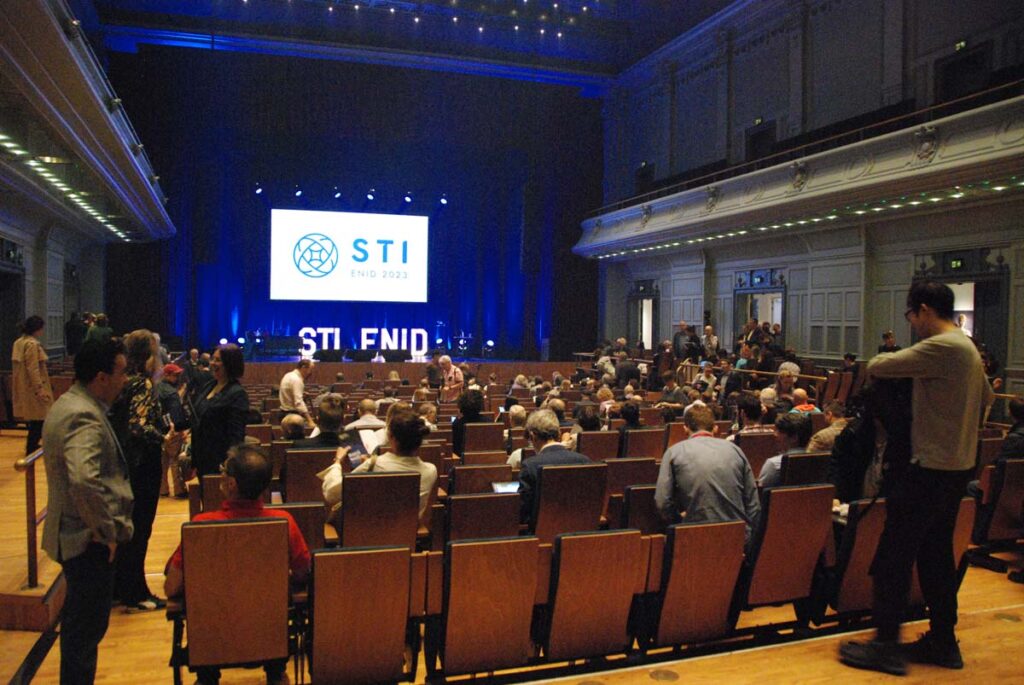
STI 2023 in Leiden: OPUS Project and Responsible and Transparent Research Assessment https://opusproject.eu/wp-content/uploads/2025/08/conference-opening-15-1024x685.jpg 1024 685 Open and Universal Science (OPUS) Project https://opusproject.eu/wp-content/uploads/2025/08/conference-opening-15-1024x685.jpgLeiden, 27–29 September 2023 – The 27th International Conference on Science, Technology and Innovation Indicators (STI 2023) convened a diverse gathering of researchers, indicator developers, and policy analysts from around the globe, all focused on advancing the methodologies and policy applications of science, technology and innovation (STI) indicators. Hosted by the Centre for Science and Technology Studies (CWTS) in partnership with the European Network of Indicator Developers (ENID), the event blended in-person and hybrid participation at Leiden’s Stadsgehoorzaal.
Themes and Discussions
The 2023 conference centred on the urgent need to improve scholarly evaluation practices in the face of significant cultural change. Key themes included:
- Reforming research assessment and advancing responsible evaluation practices
- Recognition and reward systems in academia, open science, and diverse career paths
- Metrics and indicators for open science, reproducibility, and societal impact
- Science–policy linkages and the use of STI indicators in policy development
- Equity, inclusion, and gender in research and innovation
Special sessions delved into implementing evaluation reform, recognition and reward structures, assessment practices in the global South, university ranking critiques, and the interface between open science and responsible research assessment.
The OPUS Project Presentation
A focal point of the conference was the presentation by Gareth O’Neill (TGB) on the OPUS project. O’Neill introduced OPUS-aligned evaluation themes aimed at promoting responsible and transparent research assessment, closely connected to the policy use of STI indicators. The OPUS project, funded by Horizon Europe, seeks to reform how research and researchers are evaluated by developing frameworks that incentivise open, reproducible, and societally relevant science.
O’Neill’s contribution sparked substantial interest from academic and policy audiences, especially given current transitions across Europe towards more holistic, context-sensitive assessment mechanisms. His session highlighted practical methods for integrating open science practices and responsible use of indicators in research evaluation, supporting the broader CoARA (Coalition for Advancing Research Assessment) agenda.
Who Was Present
The STI 2023 conference was attended by:
- Academic researchers and science studies experts
- Developers of bibliometric and altmetric indicators
- Policy analysts and advisors from national and international agencies
- Science managers and research evaluators
- Stakeholders engaged in research policy, funding, and institutional leadership
Networking and Innovation
Participants engaged in lively poster sessions, discussions, and plenary talks, furthering international collaboration and knowledge exchange on research evaluation challenges and best practices. The event was also notable for innovations like open review of submissions, hybrid accessibility, and hands-on workshops.