Final Lithuanian OPUS pilot event in Vilnius
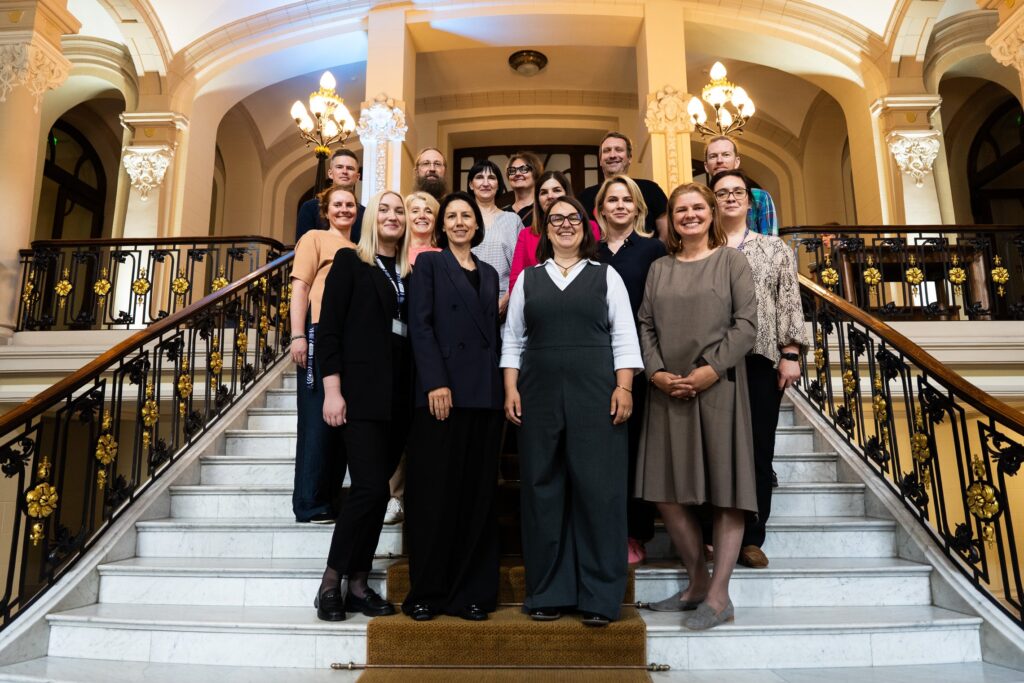
Final Lithuanian OPUS pilot event in Vilnius https://opusproject.eu/wp-content/uploads/2025/08/aiWHj0_2w0U.jpg__2280x1520_q85_ALIAS-newshudge_crop-smart_subsampling-2_upscale-1024x683.jpg 1024 683 Open and Universal Science (OPUS) Project https://opusproject.eu/wp-content/uploads/2025/08/aiWHj0_2w0U.jpg__2280x1520_q85_ALIAS-newshudge_crop-smart_subsampling-2_upscale-1024x683.jpgOn 19 June 2025, the final Lithuanian event of the OPUS (Open and Universal Science) project took place in Vilnius at the Research Council of Lithuania (LMT). The gathering brought together researchers from various fields, institutional representatives, policymakers, and experts to review the outcomes, challenges, and future actions of their shared nine-month pilot journey, aimed at strengthening open science culture in Lithuania.
Dr Vaiva Priudokienė, Deputy Chair of the LMT, who has supported the project from its earliest days, emphasised that OPUS is not merely a pilot initiative, but a platform for long-term change grounded in cross-sectoral collaboration, knowledge sharing, and personal leadership.
OPUS Results: Measurable Progress and an Invitation to Continue Together
According to project coordinator Julija Baniukevič, OPUS is more than a pilot project. “It was a community-building process that not only succeeded in promoting the implementation of open science, but also opened space for an open, respectful dialogue about fundamental challenges in researchers’ daily lives.” From the very first steps, OPUS sought not only to educate and unite, but also to verify whether we are ready for change that requires both individual leadership and systemic support,” said J. Baniukevič.
Presenting the project’s progress and achievements, the coordinator emphasised that one of the most notable successes was the formation, in a short time, of an active community committed to open science. During discussions, the most pressing issues were identified and solutions sought together. This community are more than participants: these are people who not only learnt but also took on the role of teachers themselves.
Education was one of OPUS’s fundamental pillars. During the project, 21 open science trainers were prepared, researchers who conducted training for colleagues in their institutions, thereby reaching and training more than 200 researchers across Lithuania. This model allowed not only the dissemination of knowledge but also the creation of a trust-based learning network.
“Community engagement exceeded the project’s boundaries: more than 80 per cent of participants initiated discussions in their institutions, about data management, publication strategies, ethical challenges. These discussions showed that when space is provided for dialogue, not only questions arise, but also ideas, courage, and motivation to act,” stated J. Baniukevič.
All of this demonstrates that OPUS succeeded not only in mobilising open science topics but also in showing that Lithuania has a mature, responsible, and action-ready community. A community that, when working together, can move mountains.
Diverse Partnership and Open Conversations
The final event brought together representatives from various fields, arriving not only from different Lithuanian cities but also from very different segments of the science and policy landscape.
“One of OPUS project’s greatest achievements is the creation of interdisciplinary and inter-agency partnerships. In this way, the event not only shared practical insights but also reviewed different institutions’ experiences and challenges, thus creating an exceptionally rich field of shared learning,” said J. Baniukevič.
At the event, Dr Eglė Ozolinčiūtė from the Academic Ethics Control Service provided a particularly important ethical and contextual perspective on open science, data management plans, and citizen science initiatives, emphasising that openness is not merely a technical action but a cultural attitude closely linked to academic integrity, responsibility, and trust between science and society.
Dr Ieva Cesevičiūtė from Kaunas University of Technology (KTU) Library familiarised participants with Lithuanian scientific data repositories, how to choose and use them, emphasising practical aspects that both researchers and institutions encounter.
The project coordination experience and synthesis with European open science initiatives were presented by OPUS project coordinator J. Baniukevič and Gerinta Raguckaitė from LMT, highlighting the importance of synergy between political decisions and practical changes.
Vilnius University scientists Dr Justas Dapkūnas and Dr Jonas Eimontas also shared their acquired experience and practical insights, discussing publication practices and research registration experience, emerging challenges, and possible solutions. Dr Jolita Vveinhardt from Vytautas Magnus University raised fundamental questions about researchers’ motivation: what do they gain from open science? What impact do changes have on their daily work and productivity?
Meanwhile, Dr Petras Prakas from the Nature Research Centre presented how data opening principles can be applied within institutions—discussing not only theoretical aspirations but also very concrete practices.
Other Lithuanian scientists actively participated in discussions: Dr Jurgita Lazauskaitė-Zabielskė, Dr Tomas Grinys (Vilnius University), Dr Lina Draudvilienė, Dr Rytis Maskeliūnas (Kaunas University of Technology), as well as Dr Karolina Barčauskaitė (Lithuanian Research Centre for Agriculture and Forestry) and Dr Giedrius Steponaitis (Lithuanian University of Health Sciences), whose insights complemented the overall picture with perspectives and experiences from different scientific fields. The discussions were significantly enriched by OPUS advisory group members—Gerinta Raguckaitė, Dr Justina Rukšnaitė, and Dr Eglė Celešienė, who consistently accompanied the project throughout the entire process and actively engaged in deliberations about indicator application, researcher evaluation, and future open science policy directions. Their participation strengthened the discussions’ connection with broader strategic positions and helped build bridges between practice and policy.
This diverse participant composition allowed discussions to be not only enriched but also brought closer to reality, clarifying the most pressing challenges faced by both different institutions and individual research groups. It was precisely this inclusive, open format that helped the OPUS event become not merely a presentation of results but an authentic, vibrant community meeting where ideas, experiences, and questions became shared action potential.
Challenges Identified by the Community Itself
Discussions about open science development in Lithuania revealed several key challenges that must be addressed to achieve sustainable and effective implementation of this initiative.
One of the main issues is uneven data sharing traditions across different scientific fields. What has long been customary for one discipline still remains novel for another. Therefore, it is important to create more flexible solutions adapted to specific scientific areas rather than applying uniform standards to everyone.
Participants also emphasised the necessity of clear evaluation guidelines: how will we assess the provision, use, and sharing of open data? Will this become a formal criterion for evaluating researchers’ work results?
Considerable attention was also given to the lack of knowledge about licences, data management, and secondary use. It was noted that consistent education is needed in these areas, involving not only researchers but also administrative staff and policymakers.
A broader question arising from the discussion concerned science and business interaction—how to ensure that open science values are properly utilised and not used unilaterally or inappropriately.
Finally, participants spoke about personal attitudes towards change. The most frequently asked and most important question “What’s in it for me?” showed that beyond systemic solutions, researchers’ daily lives must also be considered. Open science must not only provide new opportunities but also facilitate scientists’ work, increase their visibility, and provide additional value to society.
LMT believes that such discussions as these are very important and will continue, and the OPUS project has provided a solid foundation for further changes in the open science field in Lithuania.
The OPUS project is implemented from 1 September 2022 to 31 August 2025. The project consortium includes 18 organisations actively operating at the European level and representing the full spectrum of open science components. Among them is LMT, which conducts pilot activities involving scientists from 23 research projects from 6 science and study institutions (VU, KTU, LSMU, VDU, GTC, and LAMMC). The aim of this stage, running from 1 October 2024 to 30 June 2025, is to coordinate and support measures for researcher evaluation reform at RPOs and RFOs, transitioning to a model that encourages the active application of various open science practices.