UEFISCDI webinar dedicated to Data Management Plans
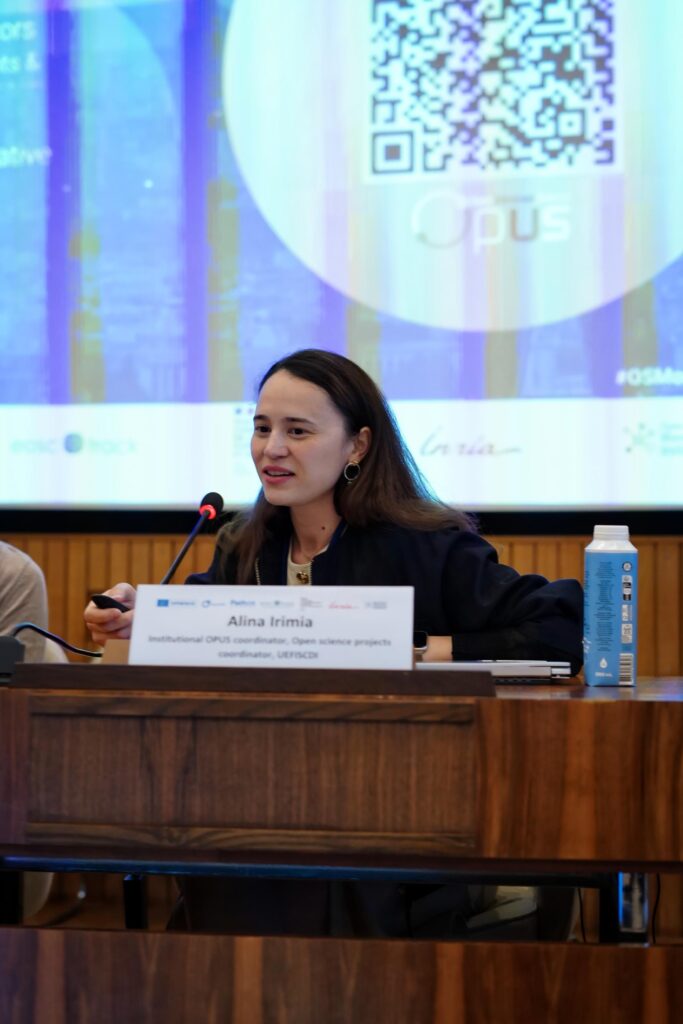
UEFISCDI webinar dedicated to Data Management Plans https://opusproject.eu/wp-content/uploads/2025/08/DSC03923-683x1024.jpg 683 1024 Open and Universal Science (OPUS) Project https://opusproject.eu/wp-content/uploads/2025/08/DSC03923-683x1024.jpgOn June 16, 2025, UEFISCDI organised a webinar dedicated to Data Management Plans within the framework of the OPUS project with approximately 170 registered participants from Romania’s research, development, and innovation (RDI) communities
OPUS Project: Reforming Research Assessment Through Open Science
The webinar opened with Dr. Alina Irimia, UEFISCDI’s Open Science Projects Coordinator, presenting the OPUS (Open Universal Science) project and Romania’s strategic contribution to this European initiative. OPUS is 36-month, €2 million Horizon Europe-funded project involving 18 partners across 11 European countries, specifically designed to reform research assessment systems at Research Performing Organisations (RPOs) and Research Funding Organisations (RFOs).
UEFISCDI’s role as a pilot Research Funding Organisation within OPUS cannot be overstated. The agency was actively testing the implementation of mandatory Data Management Plans across major national funding programmes, representing a €320 million budget allocation that will fund approximately 2,024 research projects over four to five years. This initiative represents the first systematic implementation of FAIR Data Management Plans in Romania’s research funding landscape.
The OPUS Researcher Assessment Framework
Dr. Irimia detailed the OPUS Researcher Assessment Framework (RAF), which introduces a paradigm shift in how researchers are evaluated. The framework encompasses five core dimensions:
- Research: Including data management, methods, publications, and materials
- Education: Covering courses, resources, teaching, and supervision
- Leadership: Encompassing staff management, project coordination, and organizational roles
- Valorisation: Focusing on knowledge transfer, engagement, and entrepreneurship
- Proposals: Evaluating funding acquisition and project development
Significantly, each dimension includes both generic and Open Science-specific indicators, ensuring that researchers are incentivised and rewarded for adopting open science practices.
Data Management Plans: From Theory to Implementation
The webinar’s central focus shifted to practical aspects of Data Management Plans, expertly presented by Ioana Trif and Raluca Ciobotaru, both Open Science experts from UEFISCDI’s OPUS team. Their presentation provided participants with guidance on creating effective DMPs that align with both European standards and Romanian legal requirements.
Understanding Research Data and FAIR Principles
The speakers emphasised the critical distinction between open data and FAIR data, clarifying that while all open data should be FAIR, not all FAIR data needs to be open. This nuanced understanding is essential for researchers navigating the complex landscape of data sharing, particularly when dealing with sensitive or confidential information.
The FAIR principles, making data Findable, Accessible, Interoperable, and Reusable, were positioned as the foundation for effective research data management. These principles emphasise machine-actionability, enabling computational systems to discover, access, and reuse data with minimal human intervention, thereby maximising the value and impact of research investments.
Legal Framework and National Requirements
A significant portion of the presentation addressed Romania’s evolving legal landscape for open data and research data management. Law 179/2022, which transposes EU Directive 2019/1024 on open data and reuse of public sector information, establishes the legal foundation for Romania’s open data initiatives.
Key provisions of Law 179/2022 include:
- Mandatory open access to publicly funded research data
- Implementation of the “as open as possible, as closed as necessary” principle
- FAIR principles compliance for all research data
- Commercial and non-commercial reuse permissions
- Creative Commons licensing requirements (CC BY 4.0 or CC0)
Romania’s Strategic Framework: The White Book
The webinar highlighted Romania’s comprehensive strategic approach through the White Book on the Transition to Open Science (2023-2030). This strategic document, developed through extensive consultation with the research community, outlines eight strategic objectives for Romania’s open science transition.
Strategic Objective 2, specifically addressing research data management, includes ambitious actions:
- Mandatory DMP development and updates for all publicly funded research
- Open access to research data through trusted digital repositories
- Open access metadata with CC0 licensing
- FAIR compliance with persistent identifiers (PIDs)
- Eligible RDM costs in research funding
- Comprehensive management of other research outputs including software, models, and algorithms
Practical Implementation and Tools
The webinar provided concrete guidance on DMP creation, utilising the Science Europe template as the foundation. The template addresses six core requirements:
- Data Description and Collection: Detailing data types, formats, and sources
- Documentation and Quality Assurance: Ensuring comprehensive metadata and quality control
- Storage and Backup: Establishing secure data storage during research
- Legal and Ethical Requirements: Addressing GDPR, intellectual property, and ethical considerations
- Data Sharing and Long-term Preservation: Planning for data accessibility and archival
- Responsibilities and Resources: Defining roles and allocating necessary resources
Digital Platforms and Resources
The speakers recommended several platforms for DMP development and data management:
For DMP Creation:
- DMPonline
- Argos (OpenAIRE)
- RDMO
- EasyDMP
For Data Repository Selection:
- re3data & OpenDOAR (general repositories)
- CESSDA (social sciences)
- DARIAH (digital humanities)
- ELIXIR (life sciences)
For Open Science Community Engagement:
- BrainMap Open Science Community
- UEFISCDI Open Science Network
- Creative Commons resources
- OpenAIRE platform
Impact on Romanian Research Funding
The webinar revealed that UEFISCDI is actively piloting DMP requirements across several major funding programmes:
- Centres of Excellence (CoE)
- Complex Frontier Research Projects (PCCF)
- “Challenges – Change” Programme (PPS)
These programmes represent Romania’s most significant research investments, and the inclusion of mandatory FAIR DMPs signals a fundamental shift in how research quality and impact are evaluated.
Community Feedback and Future Directions
The final segment of the webinar facilitated crucial dialogue between UEFISCDI experts and the research community. Participants provided valuable feedback on DMP implementation challenges, including:
- Technical infrastructure requirements for FAIR data management
- Training needs for researchers and data stewards
- Resource allocation for effective RDM implementation
- Institutional support mechanisms
This feedback collection process exemplifies OPUS’s stakeholder-driven approach, ensuring that policy development remains grounded in practical research realities.
Romania’s Open Science Leadership
The June 16 webinar represented more than just an information session; it marked Romania’s commitment to leading Europe’s open science transition. By systematically implementing FAIR DMPs across its research funding portfolio, Romania is positioning itself as a model for other European countries navigating similar transitions.
The success of this initiative will largely depend on continued collaboration between funding agencies, research institutions, and the broader scientific community. UEFISCDI’s approach, combining policy development with practical implementation support, provides a blueprint for effective open science adoption.
As Romania moves toward its 2030 vision outlined in the White Book, the research community can expect continued evolution in assessment criteria, funding requirements, and support mechanisms. The foundation established through the OPUS project and initiatives like this webinar ensures that Romania’s researchers will be well-equipped to thrive in an increasingly open and collaborative global research environment.
The transition to open science is not merely a policy requirement. It represents a fundamental shift toward more transparent, collaborative, and impactful research that serves both the scientific community and society at large.