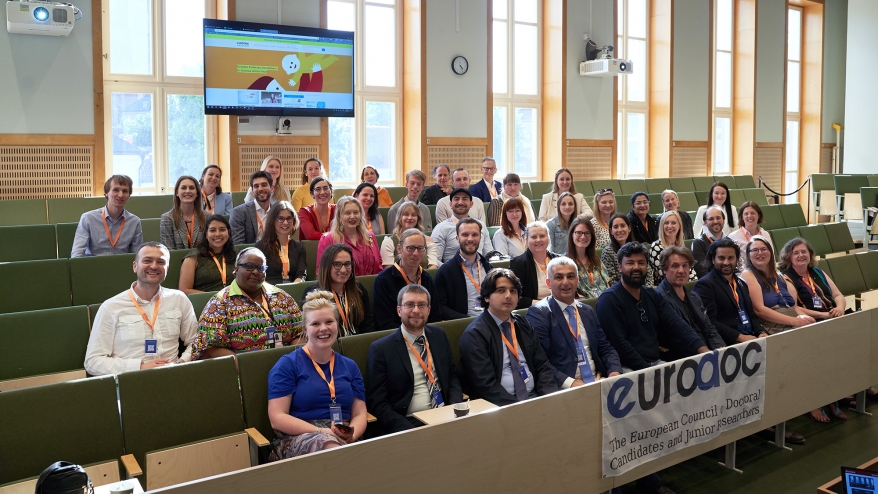
Eurodoc Conference 2023 represented OPUS in discussions about sustainable conditions for doctoral candidates and early-career researchers
Eurodoc Conference 2023 represented OPUS in discussions about sustainable conditions for doctoral candidates and early-career researchers https://opusproject.eu/wp-content/uploads/2025/08/eurodoc-conf-2023.jpg 878 494 Open and Universal Science (OPUS) Project https://opusproject.eu/wp-content/uploads/2025/08/eurodoc-conf-2023.jpgAt the Eurodoc Conference 2023 “A Sustainable Academia,” in Uppsala, Sweden, Sebastian Dahle spoke on behalf of OPUS, linking the project’s work on reforming research assessment to the broader challenge of creating sustainable conditions for doctoral candidates and early-career researchers (ECRs) in academia.
The two-day event, held in a hybrid format on 7–8 June, 2023 brought together a mix of practitioners, ECR representatives, researchers, and stakeholders focused on improving the working environment within academia. Organised by Eurodoc in partnership with Swedish student and postdoctoral associations, the conference centred on the question of how to build a sustainable academic environment that supports young professionals.
Throughout the conference, panel sessions and keynote talks highlighted the critical role that doctoral candidates and early-career researchers play in driving sustainable change in academic workplaces. Participants shared best practices from across Europe aimed at fostering healthier, more supportive conditions for ECRs and identified key knowledge gaps, setting the stage for future research on this vital topic.
Dealing with precarity: Employment conditions of post-docs
A Sustainable Academia
The Assessment of the Academic Career – a Key to Open Science
A Timely and Relevant Doctoral Education
A Sustainable Academic Psychosocial Work Environment
In addition, a special session on the state of Ukrainian academia underscored ongoing challenges faced by institutions and researchers in times of geopolitical uncertainty.
As an annual gathering focused on the experiences and needs of early-career researchers, the Eurodoc conference continues to provide a vital forum for discussion, collaboration, and advocacy, ensuring that sustainability remains at the heart of academic development.