OPUS at the MCAA Annual Conference 2024
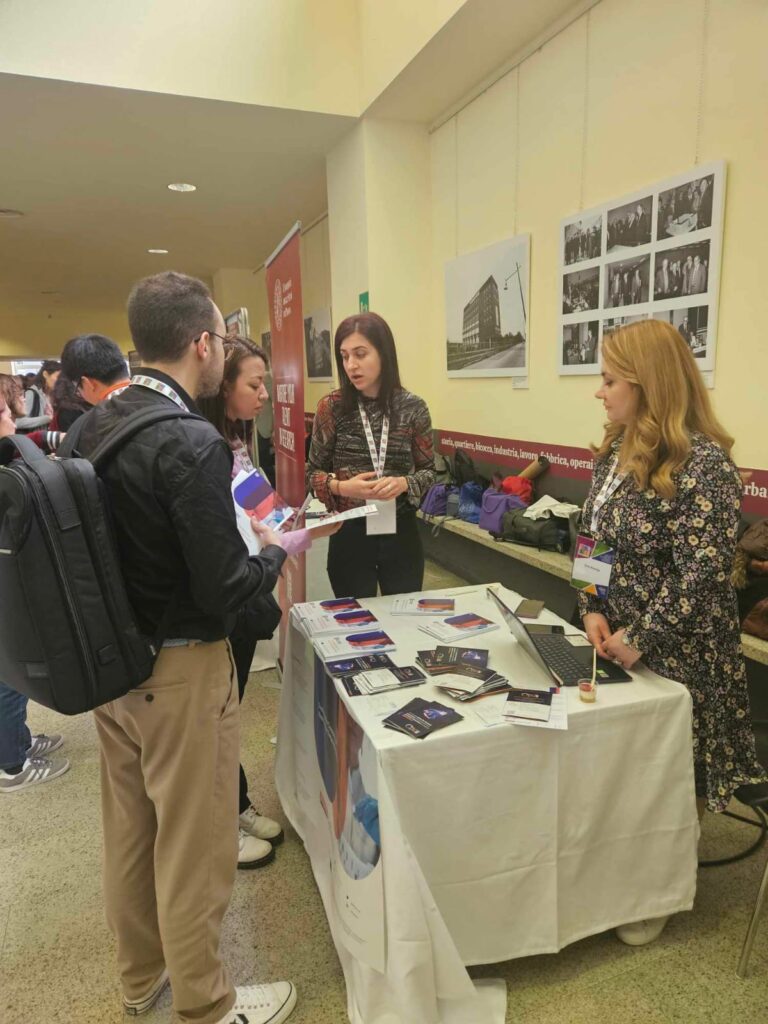
OPUS at the MCAA Annual Conference 2024 https://opusproject.eu/wp-content/uploads/2025/08/OPUS-at-the-MCAA-Annual-Conference-2024-768x1024.jpeg 768 1024 Open and Universal Science (OPUS) Project https://opusproject.eu/wp-content/uploads/2025/08/OPUS-at-the-MCAA-Annual-Conference-2024-768x1024.jpegOPUS team members Brian Cahill, Gareth O’Neill, and Clare Viney presented the project’s progress in reforming research assessment to incentivise Open Science practices at the 2024 Annual Conference Marie Curie Alumni Association (MCAA).
The 2024 annual conference and General Assembly of the Marie Curie Alumni Association (MCAA) took place at the University of Milano-Bicocca in Milano, Italy, on 14-16 March 2024. The theme of the conference is 10 Years of MCAA: Past, Present & Future.
The MCAA community brought together researchers from all career stages and scientific disciplines, MSCA project managers and stakeholders. They are encouraging networking and cooperation, making the MCAA a forum of debate between researchers and with the society.
The programme of high-level panels was complemented by training sessions, networking opportunities, and a showcase of the engagement and excellence of MCAA members.
Valuing and Rewarding Open Science in Research Assessment: Insights from the MCAA Annual Conference 2024
How can open science practices be properly recognised and rewarded when evaluating research and researchers? What role do open science activities play in assessment, and which initiatives are currently underway? Where can examples of best practice be found? These central questions were explored by Brian Cahill, Lisanna Paladin, Sam Hall, and Gareth O’Neill in a dedicated session at the MCAA Annual Conference 2024.
The Evolution of Research Assessment
As the conference marked a decade of the Marie Curie Alumni Association (MCAA), Brian Cahill began the session with an overview of policy developments in research assessment over recent years. A notable milestone was the Declaration on Sustainable Researcher Careers, a product of joint efforts between MCAA and EuroDoc, led by Gábor Kismihók in May 2019. This was swiftly followed by the launch of the NewHoRRIzon project in 2019, which examined how to establish sustainable researcher careers, implement career management services, provide training in transferable skills, and foster networking opportunities both within and beyond academia.
NewHoRRIzon led to a policy brief outlining the integration of responsible research and innovation practices in MSCA grants under Horizon 2020. The MCAA played a crucial part in establishing new evaluation criteria for the MSCA call, modernising and broadening the definition of excellence, and delivering training across multiple dimensions of research. Since then, MSCA grants have actively supported knowledge exchange and the development of communities of practice, promoting diverse and inclusive forms of excellence.
The OPUS Project: Advancing Open Science Assessment
This collective endeavour laid the foundations for the Open and Universal Science project (OPUS), which commenced in 2022, with significant involvement from the MCAA. OPUS aims to reform how research and researchers are assessed, moving towards a system that incentivises and rewards the adoption of open science. The project focuses on the development of indicators and interventions to support open science.
Gareth O’Neill, one of the panellists, elaborated, “Research assessment should centre on researchers’ activities and outputs. Fundamental principles for assessment involve redefining and developing new sets of indicators and priorities, covering the full spectrum of research activity, which should be applicable across nations, disciplines, and institutions.”
Under OPUS, open science encompasses open access to research outputs, early and open sharing of research, open peer review, reproducibility, and the involvement of all stakeholders in co-creation.
Leading Initiatives and EU Practice
A number of key initiatives now exist across Europe and globally—the most prominent being the Coalition for Advancing Research Assessment (CoARA), driving significant reform in this area. Sam Hall, representing the European Commission, discussed open research projects and their impact on research assessment. He outlined CoARA’s recommended approaches: prioritising qualitative peer review supported by quantitative indicators, maintaining the highest standards of ethics and reproducibility, recognising diverse research outputs, ensuring transparency, valuing teamwork, and supporting varied profiles and career pathways for researchers.
“As a community, we can specifically support research assessment by embracing transparency, reproducibility, and genuine innovation which together enable greater recognition and citable research outputs. Utilising a range of article types can also maximise research contributions,” Sam Hall advised. He further recommended the CRediT taxonomy as an effective tool to capture the specific contributions of each author to a research publication.